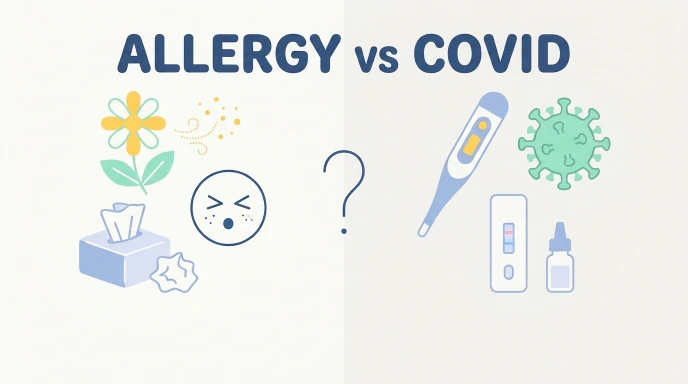
Allergies often cause itchy eyes and sneezing, while COVID-19 may cause fever, fatigue, and body aches.
Are you wondering if your symptoms are caused by allergies or COVID? A runny nose, sore throat, and sneezing can make it hard to know what is happening.Allergies often cause itchy eyes and sneezing, while COVID-19 may cause fever, fatigue, and body aches.
Allergies occur when your immune system reacts to triggers such as pollen, dust, or pet dander. COVID-19, on the other hand, is a viral infection that can affect your respiratory system and overall health.
In this guide, you will learn the key differences between allergy and COVID symptoms, how to recognise common warning signs, when to consider testing, and when to seek medical advice.
Quick Answer:
Allergies are more likely when you have itchy, watery eyes, repeated sneezing, and a clear link to pollen, dust, or pets. COVID-19 may cause fever, chills, body aches, a sore throat, or unusual fatigue, but symptoms vary. Because both conditions can cause a runny nose and cough, testing and medical advice may be needed to tell them apart.
Allergy or COVID: Quick Answer
Here are three common situations that may help you understand the difference.
- Itchy eyes and repeated sneezing: These symptoms often point toward an allergy, especially if they appear after exposure to pollen, dust, or an animal.
- Fever, chills, and body aches: These symptoms are more suggestive of an infection, including COVID-19, than of ordinary seasonal allergies.
- A runny nose and cough without other clear clues: Either condition may be responsible. Consider your exposure history, how the symptoms began, and if a COVID-19 test is appropriate.
These are clues, not diagnostic rules. COVID-19 can occur without fever, and allergies can cause several symptoms at once. Some people may also have an allergy and COVID-19 at the same time.
What Does Allergy or COVID Mean?
The phrase “allergy or COVID” describes a common question: are symptoms caused by an allergic reaction or by a viral infection?
Understanding how each condition works makes the difference easier to follow.
What Is an Allergy?
An allergy occurs when your immune system reacts to a substance that is usually harmless. These substances are called allergens.
Common allergens include:
- Pollen from trees, grasses, and weeds.
- Dust mites found in household dust.
- Pet allergens, including material from skin flakes and saliva.
- Mould spores.
Seasonal allergies, often called hay fever, commonly affect the nose and eyes. They may cause sneezing, an itchy nose, a runny or blocked nose, and watery eyes.
Symptoms can begin soon after contact with an allergen. They may return in the same season or whenever you encounter the substance that triggers them.
What Is COVID-19?
COVID-19 is an infectious disease caused by the SARS-CoV-2 virus. It can affect the respiratory system and may cause symptoms throughout the body.
Possible symptoms include:
- Fever or chills.
- Cough and sore throat.
- Runny or blocked nose.
- Tiredness and body aches.
- Headache.
- Changes in taste or smell.
- Nausea, vomiting, or diarrhoea.
Symptoms range from mild to severe. Some people have only a few symptoms, while others become seriously ill. Symptoms alone cannot reliably confirm or rule out COVID-19.
The Main Difference
The key difference is the cause. An allergy is an immune response to an allergen. COVID-19 is an infection caused by a virus.
Allergies are not contagious, but COVID-19 can spread between people. This matters when deciding if to test, limit close contact, or seek medical advice.
The Origin of the Terms
The words allergy and COVID-19 come from different scientific backgrounds.
The term allergy was introduced by Austrian paediatrician Clemens von Pirquet in 1906. It described an altered response of the body to a substance. The term later became widely used for immune reactions to allergens.
COVID-19 is a more recent name. The World Health Organization announced the disease name on February 11, 2020. “COVID-19” stands for “coronavirus disease 2019,” reflecting the year the disease was first identified.
The virus that causes it is called SARS-CoV-2. The disease name and virus name are related, but they are not interchangeable.
These terms describe different medical concepts. Their origins do not help diagnose symptoms, but they explain why one refers to an immune reaction and the other to an infectious disease.
Allergy Symptoms vs COVID Symptoms
The following table compares common symptom patterns. It is a guide, not a diagnostic tool.
| Symptom | Allergies | COVID-19 |
| Sneezing | Common | Possible |
| Itchy, watery eyes | Common | Less typical |
| Itchy nose | Common | Less typical |
| Runny or blocked nose | Common | Common |
| Cough | Possible | Common |
| Sore throat | Possible | Common |
| Fever or chills | Not typical of ordinary seasonal allergies | Possible |
| Body aches | Not typical | Possible |
| Fatigue | Possible | Common |
| Changes in taste or smell | Can occur with nasal congestion | Possible |
| Diarrhoea or vomiting | Not typical of seasonal allergies | Possible |
| Symptoms after pollen or dust exposure | May occur | Does not explain a viral infection |
Remember that symptoms vary from person to person. Not everyone with COVID-19 develops a fever, and not everyone with allergies has itchy eyes.
Which Symptoms Point More Toward Allergies?
Allergies become more likely when symptoms include:
- Itching in the eyes, nose, or throat.
- Frequent sneezing.
- Clear nasal discharge.
- Symptoms that return after exposure to a known allergen.
- A familiar seasonal pattern.
For example, a person who starts sneezing and develops itchy eyes after mowing the lawn may be reacting to pollen. If the same pattern happens every spring, an allergy becomes a reasonable possibility.
However, a familiar allergy history does not rule out an infection.
Which Symptoms Point More Toward COVID-19?
COVID-19 becomes more concerning when respiratory symptoms occur alongside fever, chills, body aches, or a marked change in how you feel.
A recent contact with someone who has COVID-19 may also increase suspicion. New symptoms without an obvious allergy trigger deserve attention, especially if they are getting worse.
Still, these signs are not proof of COVID-19. Other infections can cause similar symptoms, so testing or professional assessment may be needed.
British English vs American English
The phrase “allergy or COVID” does not have a British-versus-American spelling difference that changes its meaning. However, some related medical terms vary by region.
| British English | American English | Example |
| Hay fever | Hay fever or seasonal allergies | “My hay fever gets worse in spring.” |
| GP | Primary care doctor or primary care provider | “I will contact my GP.” |
| Chemist or pharmacy | Pharmacy or drugstore | “I will ask a pharmacist for advice.” |
| Paracetamol | Acetaminophen | Both names refer to the same medicine. |
| A&E | Emergency department or ER | “Seek emergency care for severe breathing problems.” |
Medical terms and healthcare services vary across countries. Follow the wording used by your local healthcare provider, and check medicine labels carefully.
Which Should You Suspect: Allergy or COVID?
Your symptoms and circumstances can help guide your next step.
In the United States
Check current guidance from the Centers for Disease Control and Prevention (CDC). If you have symptoms that could be COVID-19, consider testing and seek prompt medical advice if you have risk factors for severe illness. Early treatment may be available for eligible people.
In the United Kingdom
The NHS provides guidance on hay fever, allergies, and COVID-19. A pharmacist can help with common allergy symptoms. Contact an appropriate healthcare service if symptoms worsen or you are unsure what is causing them.
In Canada and Australia
Use guidance from your national or local public health service. Testing options, treatment eligibility, and recommendations may differ by location.
For International Readers
Do not rely on advice written for another country without checking local guidance. The basic symptom differences are useful worldwide, but testing and treatment recommendations may vary.
For Work, School, and Everyday Activities
If you have a fever or feel too unwell to carry out normal activities, stay home where possible and avoid close contact with others. This is especially important if you may have a contagious infection.
If symptoms are mild but unusual for you, monitor how they develop and consider testing if COVID-19 is possible.
Common Mistakes When Comparing Allergy and COVID
Mistake 1: Assuming Sneezing Always Means Allergies
Incorrect: “I am sneezing, so it must be an allergy.”
Correct: “Sneezing can happen with allergies or a respiratory infection.”
Why: Sneezing is common with allergies, but it can also occur with COVID-19 and other infections.
Memory tip: Itching points toward allergies, but it does not prove them.
Mistake 2: Assuming No Fever Means No COVID-19
Incorrect: “I do not have a fever, so I cannot have COVID-19.”
Correct: “COVID-19 can occur without a fever.”
Why: Symptoms vary. Some people with COVID-19 have mild symptoms or only a few signs of illness.
Memory tip: No fever does not mean no infection.
Mistake 3: Assuming Allergy Medicine Confirms the Cause
Incorrect: “My symptoms improved after allergy medicine, so I definitely have allergies.”
Correct: “Improvement may support an allergy explanation, but it does not confirm the diagnosis.”
Why: Symptoms can improve for several reasons, and some medicines ease symptoms that have more than one cause.
Memory tip: Symptom relief is a clue, not a diagnosis.
Mistake 4: Ignoring a Possible Infection Because You Have Allergies
Incorrect: “I get seasonal allergies, so these new symptoms must be the same thing.”
Correct: “My usual allergy symptoms may be present, but a new infection is still possible.”
Why: Allergies and COVID-19 can occur together. New fever, body aches, or unusual symptoms deserve attention.
Memory tip: A known allergy does not protect you from an infection.
Everyday Examples: How to Describe Your Symptoms
These examples show how to talk about the difference in daily life.
1. Emails
“I have a runny nose and itchy eyes, which may be due to seasonal allergies. I will monitor my symptoms and let you know if I need to stay home.”
2. Business Writing
“Because the symptoms may have an infectious cause, I will work remotely while I assess my condition.”
3. News Headlines
- “Allergy or COVID? How to Recognise Common Symptoms”
- “Itchy Eyes or Fever? Understanding the Difference Between Allergies and COVID-19”
4. Blogs
“Seasonal allergies can cause sneezing and congestion, but fever and body aches may suggest an infection. Testing can help when symptoms overlap.”
5. Social Media
“Runny nose and sneezing can have several causes. Look at the full pattern of symptoms rather than guessing from one sign.”
6. Academic Writing
“Allergic rhinitis and COVID-19 can share upper respiratory symptoms, but they differ in cause and transmission. Clinical assessment and appropriate testing may be needed to distinguish them.”
7. Daily Conversation
“I usually get itchy eyes during pollen season, but this time I also have a fever. I should not assume it is only an allergy.”
Google Trends and Modern Usage
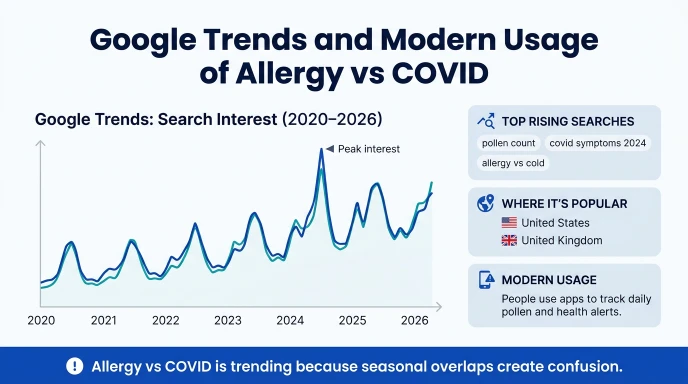
People search for “allergy or COVID” because the symptoms of both conditions can overlap. Searches often reflect a practical concern: how can someone tell if a runny nose, cough, or sore throat is caused by an allergy or an infection?
Why People Search for This Keyword
Common search questions include:
- Is sneezing a sign of allergies or COVID-19?
- Can COVID-19 cause itchy eyes?
- How can I tell if my runny nose is an allergy?
- Can allergies cause a sore throat?
- Should I take a COVID-19 test if I have allergy symptoms?
Seasonal pollen changes can make allergy symptoms more noticeable at certain times of the year. Respiratory infections may also circulate during particular periods. This can lead people to compare their symptoms with both conditions.
Regional Popularity
Search interest can vary by season, location, weather, pollen exposure, and public awareness of respiratory infections. Without a specific Google Trends query and date range, exact regional rankings or search volumes should not be claimed.
For an article, compare the keyword with related phrases such as “allergy symptoms vs COVID,” “allergies or COVID symptoms,” and “how to tell allergies from COVID.” Use Google Trends to explore interest over time and by region rather than inventing numerical findings.
Modern Usage
The phrase is commonly used as a question rather than a formal medical term. It captures the reader’s need to make sense of symptoms quickly.
The most helpful content answers that question directly, explains the limits of symptom comparisons, and provides safe next steps. Avoid promising that a simple checklist can diagnose COVID-19.
Quick Comparison:
| Version | Meaning | Correct? | Typical clue | Example |
| Allergy | Immune reaction to an allergen | Yes | Itching and repeated sneezing | Symptoms begin around pollen |
| COVID-19 | Illness caused by SARS-CoV-2 | Yes | May include fever and body aches | Symptoms develop after exposure |
| Both conditions | Allergy and infection at the same time | Possible | Mixed symptoms | Itchy eyes plus a new fever |
| Neither condition | Another cause, such as a different respiratory infection | Possible | Depends on the illness | Sore throat with other cold symptoms |
The table is a guide to common patterns. It cannot establish a diagnosis.
Key Takeaways
- Allergies are immune reactions to substances such as pollen, dust, and pet allergens.
- COVID-19 is an infectious disease caused by SARS-CoV-2.
- Itchy, watery eyes and repeated sneezing often suggest allergies.
- Fever, chills, and body aches can point toward an infection.
- A runny nose, cough, or sore throat can occur with either condition.
- A history of allergies does not rule out COVID-19.
- Testing and medical advice may help when symptoms overlap.
- Severe breathing problems or other emergency warning signs require immediate medical attention.
FAQs
Q1: Does COVID have the same symptoms as allergies?
Some symptoms overlap, but they are not the same. Both can cause a runny nose, congestion, cough, sore throat, and tiredness. COVID is more likely to bring fever, chills, body aches, and shortness of breath, while allergies are more likely to cause itchy eyes, itchy throat, and repeated sneezing without a fever. Because the overlap is large, a COVID test is the only reliable way to tell the two apart.
Q2: How do I know if I’m sick or it’s just allergies?
Look at the pattern and the triggers. Allergies often follow a clear cause, such as pollen, dust, or pets, can last for weeks, and usually bring itchy, watery eyes. An infection such as COVID, the flu, or a cold tends to start suddenly, may include fever or body aches, and usually improves within one to two weeks. If you are unsure, take a home COVID test and speak with a doctor or pharmacist, especially if your symptoms are new or getting worse.
Q3: What are the signs that your body is fighting COVID?
Common signs include fever or chills, cough, sore throat, fatigue, muscle or body aches, headache, congestion, and a runny nose. Some people also notice a change in taste or smell, nausea, or diarrhea. Symptoms vary by person, by variant, and by vaccination history, so there is no single pattern. Rest, fluids, and testing are sensible first steps, and a health professional can guide treatment if you are at higher risk.
Q4: What can COVID symptoms be mistaken for?
COVID symptoms are often mistaken for the common cold, the flu, seasonal allergies, RSV, strep throat, and sinus infections. These illnesses share signs such as cough, sore throat, congestion, and fatigue. The flu also causes fever and body aches, which makes it especially hard to separate from COVID without a test. A rapid or PCR test, along with advice from a doctor, is the best way to find the real cause.
Q5: What are non-COVID symptoms?
Symptoms that point more toward allergies than COVID include itchy or watery eyes, frequent sneezing, an itchy nose or throat, and symptoms that return at the same time each year. A runny nose with clear mucus and no fever also leans toward allergies. These signs are not a guarantee, because a person can have allergies and COVID at the same time. When you are not sure, testing gives a clearer answer than guessing.
Q6: Can you only have mild symptoms of COVID?
Yes, many people have only mild symptoms, such as a sore throat, a stuffy nose, or a low-grade fever. Vaccination, previous infection, and general health often make the illness milder. Even so, a mild case can still spread to others, so staying home and following local public health guidance is wise. Get urgent medical care for trouble breathing, ongoing chest pain, confusion, or bluish lips or face.
Conclusion
When comparing allergy or COVID symptoms, the most important difference is the cause. Allergies happen when your immune system reacts to an allergen, while COVID-19 is caused by a virus. Both can cause a runny nose, congestion, coughing, and a sore throat, which makes them difficult to distinguish by symptoms alone.
Itchy eyes, repeated sneezing, and a clear connection to pollen or dust often point toward allergies. Fever, chills, and body aches may suggest an infection. However, these patterns are not certain, and both conditions can occur at the same time.
Pay attention to changes in your symptoms, consider a COVID-19 test when appropriate, and follow local medical guidance. If you are at higher risk of severe illness, seek medical advice promptly. Get emergency help for serious breathing problems, chest pain, or signs of a severe allergic reaction.
The safest approach is to use symptoms as clues, not as a final diagnosis. If your symptoms are unusual, getting worse, or difficult to explain, ask a healthcare professional for advice.
Remember: Similar symptoms do not always mean the same condition. Share this guide with someone who may find it useful, and consult a qualified healthcare professional when you need help understanding your symptoms.

I’m Daniel Carter, a language writer and grammar enthusiast who enjoys making English simple and easy to understand. I write about grammar, spelling, word usage, and common mistakes to help readers use English with more confidence.





1 thought on “Allergy or COVID? How to Tell the Difference”