“Kielbasa” is the correct and standard spelling of this Polish sausage, while “kielbasi” is a common variant you will mostly see used as a plural or a misspelling in American English.
The word comes from the Polish “kiełbasa,” which simply means sausage. In Poland, the plural form is actually “kiełbasy,” not “kielbasi.”
English speakers often add an “i” because it sounds like Italian words such as “salami” or “panini.” That habit explains why both spellings show up on menus, grocery labels, and recipe blogs.
Dictionaries like Merriam-Webster treat “kielbasa” as the main entry, so it is the safest choice for writing and cooking content. Using it also helps your text look accurate and trustworthy to readers and search engines.
Below, you will learn where each spelling comes from, how to pronounce it, and which form to use in a sentence. By the end, you will know exactly how to spell kielbasa, if you are shopping, cooking, or writing.
The Quick Answer:
Kielbasa is the standard Polish word for sausage and is widely used in English to describe Polish sausage. Kielbasi is sometimes used in English as a plural form, but it is not the standard Polish plural. In Polish, kiełbasa is singular, and kiełbasy is a common plural form. English writers usually use kielbasa for both one sausage and the food in general.
Kielbasa or Kielbasi: Quick Answer
Choose kielbasa for most English writing. It is the familiar spelling used in American supermarkets, recipes, and restaurant menus.
Here are three examples:
- Correct: I bought a kielbasa for dinner.
- Correct: We served kielbasa with potatoes and onions.
- Understandable but less standard: We grilled several kielbasi for the party.
The third sentence uses an English-style plural. Some readers will understand it, but kielbasa sausages or simply kielbasa is usually clearer.
Remember that the Polish plural is generally kiełbasy, not kielbasi. The letter ł in Polish is commonly represented by l in English-language spellings that omit Polish diacritics.
What Does Kielbasa Mean?
Kielbasa is a Polish word that means sausage. In English, it commonly refers to Polish-style sausage, especially smoked or cured varieties sold in grocery stores.
Traditional Polish sausages come in many forms. They can differ in ingredients, seasoning, preparation methods, and texture. Some are smoked, while others are fresh and require cooking before they are eaten.
The word kielbasa is used in several ways:
- As a food name: Kielbasa is popular at family cookouts.
- As a recipe ingredient: Add sliced kielbasa to the skillet.
- As a product name: The store sells several types of Polish kielbasa.
- As a general noun: We served kielbasa with sauerkraut.
In English, food names often work as uncountable nouns when people refer to the food in general. For example, someone might say, “We ate chicken for dinner,” without using a plural form.
Kielbasa often follows the same pattern. When you need to count individual sausages, you can write “two kielbasa sausages” or “two links of kielbasa.”
The Origin of Kielbasa
The word kielbasa comes from Polish. Its original Polish spelling is kiełbasa, which means sausage.
Polish uses the letter ł, which has a different sound from the English letter L. When Polish words are written for English-speaking readers, special characters are often removed. That is why kiełbasa commonly becomes kielbasa in English.
The word entered wider English use through Polish food traditions and the migration of Polish communities to countries such as the United States. Polish immigrants brought their cooking methods, family recipes, and sausage-making traditions with them.
Over time, kielbasa became familiar in American grocery stores, restaurants, and cookbooks. Today, the word often describes a particular style of Polish sausage rather than every kind of sausage found in Poland.
The spelling kielbasi reflects an attempt to form an English plural. However, Polish does not form the plural by simply replacing the final a with i. The common Polish plural is kiełbasy.
It is useful to separate the two language systems:
- Polish: kiełbasa, with kiełbasy as a common plural.
- English: kielbasa, often used for the food in general.
- Informal English plural: kielbasi, sometimes used but less standard.
This difference explains why readers may encounter several forms without all of them having the same status.
British English vs American English
There is no major British-versus-American spelling difference for kielbasa. Both varieties of English commonly use the same spelling.
The main difference is how writers express quantity and how much detail they include when describing the food.
| British English | American English | Example |
| Kielbasa | Kielbasa | We bought kielbasa for dinner. |
| Kielbasa sausages | Kielbasa sausages | Two kielbasa sausages were left. |
| Polish sausage | Polish sausage | The recipe calls for Polish sausage. |
| Kiełbasa in specialist Polish contexts | Kiełbasa in specialist Polish contexts | The menu uses the original Polish spelling. |
Regional differences
In the United States, kielbasa is a familiar name for Polish-style sausage. It often appears on food packaging and in recipes.
In the United Kingdom, people may also use Polish sausage when writing for readers who are less familiar with the word. However, kielbasa remains a valid and recognizable spelling.
Canadian and Australian writers can use kielbasa as well. The word does not require a special spelling change based on local English conventions.
What do style guides recommend?
General English style guides tend to favor clarity and consistency. They do not require writers to create an unusual plural when a clear alternative is available.
For a general audience, kielbasa sausages, links of kielbasa, or simply kielbasa will often read more naturally than kielbasi.
If you are writing about Polish language or traditional Polish cooking, use the appropriate Polish form and preserve the original spelling when practical.
Which Version Should You Use?
The best choice depends on your audience and the kind of writing you are doing.
United States
Use kielbasa. It is the familiar English spelling used in most American food writing.
Example: “Grill the kielbasa until it is heated through.”
United Kingdom
Use kielbasa or Polish sausage, depending on your audience.
Example: “Serve the Polish sausage with mustard and roasted vegetables.”
Canada
Use kielbasa in recipes, menus, and general writing. Add a short description if your readers may not know the word.
Example: “Slice the kielbasa, a Polish-style sausage, before cooking.”
Australia
Use kielbasa as the standard spelling in English.
Example: “Add the kielbasa to the pan with the onions.”
International writing
Choose kielbasa and explain that it is a Polish sausage when necessary. Avoid switching between several spellings without a reason.
Academic writing
Use the spelling required by your institution or publication. If the subject is Polish language, retain kiełbasa and explain its plural forms accurately.
Business writing
For product labels, restaurant menus, and food descriptions, choose the form customers will understand immediately. Kielbasa is a practical default, while Polish sausage can help explain the product.
Common Mistakes
Writers sometimes assume that every noun ending in a forms a plural ending in i. That rule does not apply to every foreign word.
Here are common mistakes to avoid.
| Incorrect or less suitable example | Better example | Explanation |
| I bought three kielbasi. | I bought three kielbasa sausages. | The revised version is clear and natural in general English. |
| We ate two kielbasa. | We ate two kielbasa sausages. | Adding sausages makes the count clear. |
| The Polish plural is kielbasi. | A common Polish plural is kiełbasy. | Polish uses its own plural rules. |
| I cooked a kielbasi for lunch. | I cooked a kielbasa sausage for lunch. | The singular form is kielbasa. |
| Kiełbasa and kielbasa are unrelated words. | Kiełbasa is the original Polish spelling. | The English form usually omits the diacritic. |
A simple memory tip
Think of kielbasa as the safe English choice.
If you need to count the sausages, add a counting word:
- One kielbasa sausage
- Two kielbasa sausages
- Three links of kielbasa
This approach avoids confusion and works well in recipes, shopping lists, and everyday conversation.
Everyday Examples
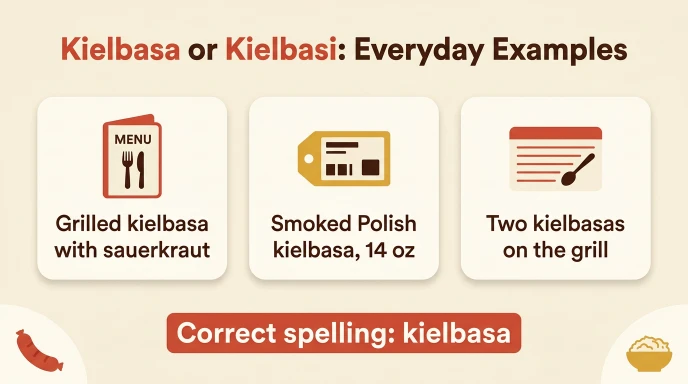
The following examples show how to use kielbasa naturally in different situations.
Emails
“Could you please buy kielbasa for the family dinner on Saturday?”
This sentence uses the word as a general food name.
Business writing
“Our new meal kit includes Polish kielbasa, potatoes, and seasonal vegetables.”
This wording identifies the product and gives customers a clear idea of the ingredients.
News headlines
“Local Festival Celebrates Polish Food and Kielbasa Traditions”
The singular food name works naturally in a headline.
Blogs
“Smoked kielbasa adds a rich, savory flavor to soups and stews.”
This example shows how the word can be used in food writing.
Social media
“Tonight’s dinner: grilled kielbasa, roasted potatoes, and fresh vegetables.”
The spelling is familiar and easy to understand.
Academic writing
“The Polish noun kiełbasa means sausage, while kiełbasy is a common plural form.”
This sentence distinguishes the original Polish word from its English adaptation.
Daily conversation
“Would you like some kielbasa with your eggs?”
The word refers to the food rather than to a specific number of sausages.
Shopping lists
“Buy two kielbasa sausages and a bag of onions.”
Adding a countable noun makes the quantity precise.
Google Trends and Modern Usage
People may search for kielbasa or kielbasi because they have seen both forms in recipes, food blogs, grocery listings, or conversations.
The confusion is easy to understand. English speakers often add endings to foreign words to make them plural, but the correct form depends on how the word works in its original language and how English speakers have adopted it.
Several factors help explain the continued use of both spellings:
- Food traditions: Polish food is part of many family and community traditions.
- Recipe websites: Different writers may use different plural forms.
- Search behavior: Readers often search for two spellings when they want to confirm which is correct.
- English grammar: People naturally look for familiar plural patterns.
- Original Polish spelling: Readers may encounter kiełbasa and wonder how it relates to kielbasa.
The spelling kielbasa is widely recognizable in English. Kielbasi also appears in informal usage, but that does not make it the standard Polish plural.
No specific Google Trends figures are presented here. Without checking a defined region and time period, it would be misleading to claim exact search volumes or popularity percentages.
For writers who want to reach a broad audience, kielbasa is the most practical primary spelling. Related phrases such as Polish sausage, kielbasa recipes, and how to spell kielbasa may help address related reader questions naturally.
Quick Comparison
| Version | Meaning | Correct? | Region | Example |
| Kielbasa | Polish sausage; common English food name | Yes | International English | We cooked kielbasa. |
| Kiełbasa | Original Polish spelling for sausage | Yes | Polish language | Kiełbasa is a Polish word. |
| Kiełbasy | Common Polish plural form | Yes | Polish language | Several kiełbasy were prepared. |
| Kielbasi | Informal English plural sometimes used | Less standard | Some English usage | The menu lists grilled kielbasi. |
| Kielbasa sausages | Clear English plural phrase | Yes | International English | We grilled two kielbasa sausages. |
The main lesson is that a word can have an accepted spelling in its original language and a different pattern of use in English. Knowing the audience helps you select the clearest form.
Key Takeaways
- Kielbasa is the standard spelling for the Polish sausage in English.
- The original Polish spelling is kiełbasa.
- Kiełbasy is a common Polish plural form.
- Kielbasi appears as an English-style plural but is less standard.
- British and American English generally use the same spelling, kielbasa.
- Use kielbasa sausages or links of kielbasa when you need to specify a number.
- In academic writing about Polish, distinguish the original Polish spelling from the English adaptation.
- When in doubt, choose kielbasa for clear, natural English.
FAQs
Is It Kielbasa or Kielbasi?
The correct spelling is kielbasa. It is the standard English form of the Polish word “kiełbasa,” and dictionaries list it as the main entry. “Kielbasi” is not a Polish word, but it shows up in American English as a plural or casual variant, probably because it sounds like Italian words such as “salami.”
Quick guide:
- One sausage: “I bought a kielbasa.”
- Several sausages: “kielbasas” in English, or “kiełbasy” in Polish
- Safe choice for menus, recipes, and blog posts: kielbasa
How Do Polish People Pronounce Kielbasa?
In Polish, kiełbasa is pronounced roughly “kyew-BAH-sah,” with the stress on the second-to-last syllable. The Polish letter “ł” sounds like the English “w,” which is why the first syllable sounds like “kyew” rather than “kil.”
Most Americans say “kil-BAH-suh,” which is perfectly understood in shops and restaurants. If you want to sound closer to a native speaker, soften the first syllable and keep the “ah” sound clear and open.
What Is Kielbasa in English?
In English, kielbasa means Polish sausage. In Poland, the word simply means “sausage” in general, but in the United States it usually refers to a smoked, garlicky sausage, most often made from pork, and sometimes beef or turkey.
It is a staple of Polish cuisine and is often served with sauerkraut, pierogi, mustard, or on a bun. Many Polish families also include it in the Easter basket that is blessed on Holy Saturday, which shows how deeply it is tied to tradition.
Why Do People Call Kielbasa “Kabasi”?
People say “kabasi” mainly because of regional speech habits. In some Polish-American communities in the United States, the word was shortened over generations, and the sounds “kiel” and “ba” blurred into a quicker, softer “kabasi” or “kobasi.”
Another reason is the English habit of ending sausage words in “i,” as in salami. The result is a spoken nickname rather than a standard spelling, so it is better to write “kielbasa” in articles and recipes.
What Else Is Kielbasa Called?
Kielbasa goes by several names depending on language and region. In English, it is usually called Polish sausage, while in other Slavic and Central European languages you will find close relatives such as “kolbász” in Hungarian and “klobása” in Czech and Slovak.
Poland itself has many regional types, including:
- Kiełbasa wiejska: country-style sausage
- Kiełbasa krakowska: Kraków-style sausage
- Kiełbasa biała: fresh white sausage, popular at Easter
- Kiełbasa śląska: Silesian sausage
What Is Kabasi?
Kabasi is not a different food. It is the same Polish sausage, just written the way some people say it. You will mostly hear it in casual conversation, family kitchens, and local dialects rather than in dictionaries or on packaging.
If you see “kabasi” or “kobasi” on a menu or in a comment, you can safely read it as kielbasa.
Conclusion
When choosing between kielbasa and kielbasi, the safest option for most English writing is kielbasa. It is the familiar spelling used in American food writing and is also understood in British, Canadian, Australian, and international English.
The confusion comes from the difference between Polish grammar and English usage. Polish uses kiełbasa for the singular and kiełbasy as a common plural. English often uses kielbasa as a general food noun, while some writers form the plural kielbasi. That informal form may be understood, but it is not the standard Polish plural.
For recipes, emails, menus, and everyday conversation, you can keep your writing clear by using kielbasa when referring to the food in general. When you need to count individual sausages, choose phrases such as two kielbasa sausages or three links of kielbasa.
If you are writing about the Polish language itself, preserve the original spelling kiełbasa and explain the plural accurately.
The easiest rule to remember is this: use kielbasa in English, and use kiełbasa and kiełbasy when the Polish spelling and grammar matter. Keep this distinction in mind the next time you write a recipe or describe a favorite Polish dish.

I’m Daniel Carter, a language writer and grammar enthusiast who enjoys making English simple and easy to understand. I write about grammar, spelling, word usage, and common mistakes to help readers use English with more confidence.