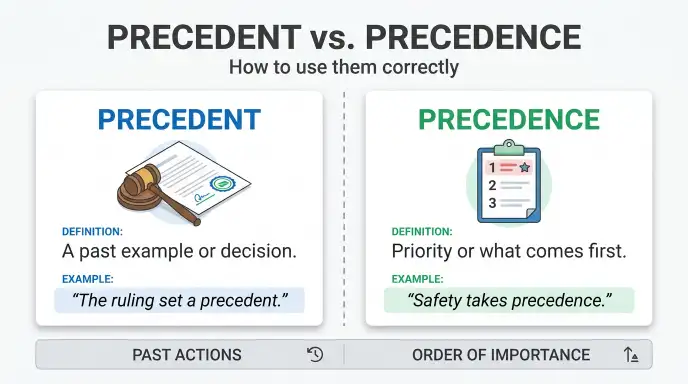
Precedent vs. precedence: “precedent” is an earlier example or decision that guides later ones, while “precedence” means priority or higher importance.
The two words look almost identical, which is why they are so easy to mix up. Both come from the Latin idea of “going before,” but English gave them different jobs. One points to something that happened earlier, and the other points to what comes first in rank.
For example, a court may follow a legal precedent from a past case, and a manager may give precedence to an urgent task. In math, the order of operations also uses precedence to decide which step comes first. As a result, choosing the wrong word can change the meaning of a sentence.
A simple memory trick can help you here. “Precedent” ends in “-ent” like “event,” so think of a past event that sets an example, and “precedence” ends in “-ence” like “importance,” so think of priority. With this in mind, you can pick the right word quickly.
In this guide, you will learn the exact difference between precedent and precedence, how to use each word correctly, and which one fits legal, business, and everyday writing. You will also find examples, common mistakes, and answers to frequently asked questions to help you write with confidence.
Precedent vs. Precedence: Featured Snippet Answer
Precedent means a previous action, event, or decision that can guide future choices. Precedence means priority or the right to come before something else. For example, a court may follow a legal precedent, while a company may give customer safety precedence over profit. Both words are correct, but they are not interchangeable.
Precedent vs. Precedence: Quick Answer
The easiest way to remember the difference is to focus on what you mean.
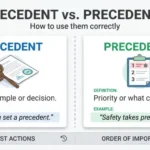
- Precedent = a previous example. “The court followed an earlier precedent.”
- Precedence = priority. “Safety takes precedence over speed.”
- Precedents is the plural of precedent. Precedence is usually an uncountable noun, so it does not normally take a plural ending.
Both words are nouns. Both relate to the idea of coming before something. However, precedent usually points to an earlier example, while precedence describes order, importance, or priority.
What Does Precedent Mean?
A precedent is an earlier event, action, decision, or example that helps guide a later decision. It can show what has been done before and what people may expect to happen again.
The word is common in law, business, politics, education, and everyday conversation.
Examples of precedent
- Law: The judge considered a previous ruling as a precedent.
- Business: The company did not want to set a precedent by allowing one employee to ignore the policy.
- Education: The school’s earlier decision provided a precedent for handling similar cases.
Common phrases with precedent
- Set a precedent: Do something that may become an example for future situations.
- Follow a precedent: Act in a way that matches an earlier decision or practice.
- Break with precedent: Do something different from what was done before.
- Without precedent: Having no known earlier example of the same kind.
For example, “The new policy sets a precedent for remote work” means the policy could influence how similar requests are handled in the future.
In legal writing, a precedent can be a court decision used to guide later cases. Its authority depends on the legal system, the court involved, and the facts of the case. Not every earlier ruling is binding on every later court.
What Does Precedence Mean?
Precedence means priority, order of importance, or the right to come before someone or something else. It is often used when two or more needs, rules, tasks, or interests compete.
Examples of precedence
- Work: Urgent customer complaints take precedence over routine tasks.
- Safety: Emergency procedures take precedence over normal office routines.
- Scheduling: The deadline takes precedence over less urgent work.
In each example, one thing receives priority over another.
Common phrases with precedence
- Take precedence over: Have greater priority than something else.
- Give precedence to: Treat something as more important or deal with it first.
- Order of precedence: An established ranking or order of priority.
- Precedence over someone or something: The right to come before another person or thing.
For example, “The safety rules take precedence over convenience” means safety rules must be given priority.
Precedence also appears in technical writing. In mathematics and programming, operator precedence describes which operations are evaluated first in an expression. This is another example of the word referring to order rather than a past decision.
The Origin of Precedent and Precedence
The two words are related because both come from the idea of going before something.
They trace back to the Latin verb praecedere, meaning “to go before” or “to precede.” The Latin word combines prae, meaning “before,” with cedere, meaning “to go.” Both words entered English through historical forms connected to Latin and French.
How precedent developed
Precedent appeared as a noun in English in the early 15th century. It referred to an earlier instance, custom, or established practice that could guide later actions.
Over time, the word became especially important in legal language. A previous judicial decision could serve as a guide for deciding a similar case.
How precedence developed
Precedence appeared in English in the late 15th century. Its meaning developed around the idea of coming before another person or thing, especially in rank, order, or importance.
Today, the difference is clear:
- Precedent focuses on what happened before and can guide future action.
- Precedence focuses on what should come first or receive priority.
The spelling difference comes from their different word endings, not from a British-versus-American spelling rule.
British English vs. American English
There is no standard British-versus-American spelling difference between precedent and precedence. Both words are used in the United Kingdom, the United States, Canada, Australia, and other English-speaking regions.
| British English | American English | Example |
|---|---|---|
| Precedent | Precedent | The ruling established a precedent. |
| Precedence | Precedence | Safety takes precedence over speed. |
| Legal precedent | Legal precedent | The court reviewed the legal precedent. |
| Order of precedence | Order of precedence | The guests followed the order of precedence. |
Are there regional differences?
The basic meanings remain the same across major varieties of English. Differences are more likely to arise from local legal systems, workplace conventions, and writing styles than from the words themselves.
British and American legal systems may treat particular precedents differently. That is a difference in legal practice, not a difference in spelling.
What do style guides recommend?
Use the spelling that appears in both major varieties of English, and choose the word that fits your meaning.
For formal writing, follow your organization’s style guide and the relevant legal or academic conventions. A style guide may govern capitalization, punctuation, and document format, but it does not make precedent and precedence interchangeable.
Which Version Should You Use?
The choice depends on your intended meaning, not your location. Use precedent for an earlier example or decision. Use precedence for priority or order.
- United States: Use precedent for prior court decisions and past examples. Use precedence for priority.
- United Kingdom: Apply the same distinction in everyday, professional, and legal writing.
- Canada: Use either word according to its meaning, while following the relevant Canadian legal or editorial conventions.
- Australia: Use the same standard meanings and follow your organization’s preferred style.
- International writing: Choose the word that best expresses your intended idea. Both are widely understood.
- Academic writing: Use precedent when discussing earlier research decisions, cases, or practices. Use precedence when explaining which factor or principle has priority.
- Business writing: Use precedent for a decision that may guide future policy. Use precedence when explaining which task, goal, or rule comes first.
A simple decision test
Ask yourself these questions:
- Am I talking about something that happened before and may guide future action? Use precedent.
- Am I talking about something that should come first or matter more? Use precedence.
For example, “This decision sets a precedent” refers to its possible influence on future decisions. “This deadline takes precedence” means the deadline has priority.
Common Mistakes
These words are easy to confuse because their spelling and meanings are closely related. The following examples show how to correct common errors.
| Incorrect example | Correct example | Explanation |
|---|---|---|
| Safety takes legal precedent over speed. | Safety takes precedence over speed. | The sentence describes priority. |
| The ruling set a new precedence. | The ruling set a new precedent. | The ruling may guide future decisions. |
| This task has more precedent than that one. | This task takes precedence over that one. | The sentence compares priority. |
| The court followed the precedence. | The court followed the precedent. | The court relied on an earlier decision. |
| We must establish a precedence for future cases. | We must establish a precedent for future cases. | The intended meaning is an example for later cases. |
Some incorrect forms may appear in informal writing or specialized contexts, but the corrected versions are the natural choices for these intended meanings.
Memory tip: Think of an example versus a priority
Remember these two short definitions:
- Precedent = past example.
- Precedence = priority.
You can also connect precedent with the phrase “set a precedent” and precedence with the phrase “take precedence.”
If you can replace the word with example, choose precedent. If you can replace it with priority, choose precedence.
Everyday Examples of Precedent and Precedence
The best way to learn the difference is to see how each word works in real situations.
1. Emails
Precedent:
“The previous approval may serve as a precedent for similar requests.”
This means an earlier approval may guide future decisions.
Precedence:
“Please address the client’s urgent issue first, as it takes precedence over routine requests.”
This means the urgent issue has higher priority.
2. Business writing
Precedent:
“Allowing this exception could set a precedent for future contract negotiations.”
Precedence:
“Regulatory compliance takes precedence over short-term cost savings.”
The first sentence concerns future expectations. The second establishes a priority.
3. News headlines
Precedent:
“Court Ruling Sets Precedent for Future Cases”
Precedence:
“Public Safety Takes Precedence in New Transport Policy”
The first headline focuses on the influence of a past decision. The second focuses on a priority.
4. Blogs
Precedent:
“The company’s first flexible-work policy set a precedent for other teams.”
Precedence:
“When planning your day, give your most important tasks precedence over minor distractions.”
These examples show how the words apply to work habits and organizational decisions.
5. Social media
Precedent:
“This decision could set a dangerous precedent.”
Precedence:
“Your health should take precedence over a busy schedule.”
Both sentences are concise and natural, but they express different ideas.
6. Academic writing
Precedent:
“Earlier studies provide a precedent for using this research method.”
Precedence:
“In this analysis, accuracy takes precedence over speed.”
In academic writing, precedent can refer to an earlier method or practice. Precedence can describe the order in which goals, principles, or operations are considered.
7. Daily conversation
Precedent:
“Has anyone done this before? I don’t want to set a bad precedent.”
Precedence:
“Getting home safely takes precedence over arriving on time.”
These are useful models for speaking naturally without confusing the two words.
Google Trends and Modern Usage
People search for “precedent or precedence” because the words look alike, share a historical root, and are often used in formal contexts. A person writing a report, studying English, preparing a legal document, or editing a business email may need to check which word fits.
Which word is more popular?
Both words are established parts of modern English, but they serve different purposes. Precedent is common in discussions of law, policy, and past decisions. Precedence is common in discussions of priority, ranking, scheduling, and technical rules.
I have not verified live Google Trends figures for this comparison, so I will not claim that one term has a specific search-volume advantage over the other. Search popularity can vary by region, time period, and topic.
Why does the confusion continue?
There are three main reasons:
- Both words are linked to the idea of coming before something.
- Their endings are similar, which makes them easy to mix up when writing.
- Both appear in formal settings, including legal, academic, and professional documents.
The simplest solution is to learn their common word partnerships. Set a precedent refers to creating an example. Take precedence refers to having priority.
Quick Comparison:
| Version | Meaning | Correct? | Region | Example |
|---|---|---|---|---|
| Precedent | An earlier example or decision | Yes | All major English varieties | The ruling set a precedent. |
| Precedence | Priority or order of importance | Yes | All major English varieties | Safety takes precedence. |
| Precedences | Uncommon plural form | Usually avoid | Specialized contexts | Use precedence for general priority. |
| Precedents | Multiple earlier examples or decisions | Yes | All major English varieties | The court reviewed several precedents. |
The most important distinction is meaning, not region. For everyday writing, you will usually need either precedent or precedence, depending on if you mean an earlier example or a priority.
Key Takeaways
- Precedent means a previous action, event, decision, or example that can guide future choices.
- Precedence means priority, rank, or the right to come before something else.
- Use “set a precedent” when an action may influence future behavior.
- Use “take precedence over” when one thing has greater priority than another.
- Precedents is the usual plural of precedent.
- Precedence is generally used as an uncountable noun.
- Neither word is exclusive to British or American English.
- Remember: a precedent is an example; precedence is priority.
FAQs
What is the main difference between precedent and precedence?
A precedent is an earlier example or decision that can guide future actions. Precedence means priority or the right to come before something else. A court may rely on a precedent when deciding a case, while a company may give customer safety precedence over profit. The correct word depends on if you mean an earlier example or a higher priority.
What does legal precedent mean?
A legal precedent is an earlier court decision that helps guide how similar legal cases are decided. Depending on the legal system and the court involved, a precedent may be binding or persuasive. Lawyers and judges examine relevant earlier rulings to understand how legal principles have been applied. A precedent does not automatically control every later case.
Is precedence the same as priority?
Precedence and priority are close in meaning, but their usage can differ. Both can describe what matters most or should be handled first. For example, “Safety takes precedence over speed” means safety has priority. Precedence can also refer to formal rank or order, as in an official order of precedence.
What is the plural of precedent?
The plural of precedent is precedents. For example, “The judge reviewed several precedents before making a decision.” The word precedence is generally an uncountable noun and does not usually take a plural ending. If you are discussing multiple earlier decisions, use precedents, not precedences.
Are precedent and precedence spelled differently in British and American English?
No. The standard spellings are the same in British and American English. Both varieties use precedent for an earlier example or decision and precedence for priority. Differences may arise in local legal practice or editorial conventions, but there is no standard regional spelling rule that changes one word into the other.
How can I remember the difference between precedent and precedence?
Use the memory tip “precedent = past example; precedence = priority.” If you are talking about an earlier event that may guide a future decision, choose precedent. If you mean that something should come first or matters more, choose precedence. Remembering “set a precedent” and “take precedence” makes the distinction even easier.
Conclusion:
Understanding precedent vs. precedence becomes easy once you focus on the difference between an earlier example and a priority.
A precedent is something that happened before and may guide a future decision. It is common in legal discussions, business policies, academic research, and everyday conversations about past actions. You might follow a precedent, establish a precedent, or worry about setting a bad precedent.
Precedence, by contrast, means priority or order of importance. You give precedence to urgent work, allow safety to take precedence over convenience, or follow an established order of precedence.
The spelling and meaning of these words are the same in British and American English. The choice depends on your message, not your location or writing style.
Before using either word, ask yourself one question: Am I talking about an earlier example, or am I deciding what comes first? If you mean an example, use precedent. If you mean priority, use precedence.
Further Reading!
Tower or Terror: Meaning, Correct Spelling, Origin, and Usage

My name is James Whitemore, and I am a UK-based English language writer specializing in grammar, vocabulary, punctuation, and writing skills. At Grammer Vivo, I make complex English concepts easy to understand through clear explanations and practical examples, with a focus on both British and American English usage.

1 thought on “Precedent vs. Precedence: Meaning, Difference, and Examples”