“Lavender” is the correct spelling; “lavendar” is a common misspelling caused by swapping the ending “-er” for “-ar.”
Spelling mix-ups happen often in English, especially with words borrowed from other languages, and “lavender” is a perfect example. Many people find themselves unsure if it ends in “-er” or “-ar” when writing or typing quickly.
The correct spelling is “lavender,” referring to both the fragrant purple flowering plant and the pale purple color named after it. “Lavendar” is simply an incorrect variation, likely caused by confusion with other words that end in “-ar,” such as “similar” or “calendar.”
This kind of error is common because English doesn’t always follow consistent spelling patterns, and words with unfamiliar or foreign origins can be especially tricky to remember correctly.
This guide will confirm the correct spelling of “lavender,” explain why “lavendar” is incorrect, and show you how to use the word properly in sentences, so you’ll never second-guess it again.
Quick Answer
Lavender is correct, while lavendar is a common spelling mistake.
Definition and Meaning of Lavender or Lavendar
What Does Lavender Mean?
Lavender is mainly used for a fragrant plant with small purple flowers. The plant is known for its pleasant smell and is often grown in gardens.
The word is also used for a light purple color. This color takes its name from the soft purple shade commonly linked with lavender flowers.
The meaning depends on how the word is used.
For example:
The lavender smells wonderful.
Here, lavender means the plant.
She painted her room lavender.
Here, lavender describes the color.
Simple Meaning
In simple English, lavender can mean:
- A fragrant flowering plant
- The flowers or scent of that plant
- A pale purple color
The word is common in everyday speech and writing.
| Form | Meaning | Example |
| Lavender | A flowering plant | Lavender grows in the garden. |
| Lavender flowers | Flowers from the plant | She picked lavender flowers. |
| Lavender scent | The smell of lavender | The room has a lavender scent. |
| Lavender color | A pale purple shade | She chose lavender curtains. |
| Lavendar | Misspelling | Write lavender instead. |
How Is Lavender Used?
You may see lavender when people talk about gardening, flowers, colors, clothing, decoration, fragrances, or personal care.
It can describe something physical:
This garden has many lavender plants.
It can also describe a color:
I like the lavender color of this dress.
The word is easy to use once its two common meanings are clear.
The Origin of Lavender
Where Does the Word Come From?
The word lavender has a very old history. It entered English through older French forms and can be traced back to Medieval Latin.
Older forms of the word included lavendula in Medieval Latin and lavendre in Anglo-French.
The word has been connected with the lavender plant for many centuries. Lavender was valued for its fragrance and was used in ways connected with washing, bathing, and keeping things fresh.
There is also a possible connection with the Latin word lavare, which means “to wash.”
Over time, the spelling developed into the English form we use today:
lavender
The color meaning came later. People began using the name of the plant to describe a pale purple shade similar to its flowers.
Why Is “Lavendar” Common?
Lavendar is usually caused by a spelling mistake.
When people hear the word, the vowel sounds can be difficult to separate. Someone may remember the general sound but guess the wrong letter when writing it.
This is common with English words because English spelling does not always match pronunciation exactly.
Even though lavendar appears in informal writing and online searches, it is not the standard spelling.
The correct form is still:
lavender
British English vs American English Spelling
Is There a UK and US Difference?
There is no standard British-American spelling difference for this word.
Both British English and American English use:
lavender
This is different from words such as:
- colour / color
- favourite / favorite
- centre / center
Those words have recognized differences between British and American English. Lavender does not.
| Variety of English | Correct Form | Common Mistake |
| British English | lavender | lavendar |
| American English | lavender | lavendar |
| Canadian English | lavender | lavendar |
| Australian English | lavender | lavendar |
| International English | lavender | lavendar |
Examples
British English:
The lavender flowers are beautiful.
American English:
The lavender flowers are beautiful.
The spelling remains the same in both sentences.
So, you do not need to change lavender when writing for American or British readers.
Which Spelling Should You Use?
For American Readers
Use lavender.
Do not change it to lavendar. The American spelling is the same as the British spelling.
Example:
She bought a lavender sweater.
For British and Commonwealth Readers
Use lavender here too.
Readers in the UK and other Commonwealth countries do not normally use lavendar as an accepted spelling.
Example:
The lavender plants grew well in the garden.
For a Global Audience
The best choice is also lavender.
If you are writing for people from different countries, there is no need to create different versions of this word.
| Audience | Spelling to Use | Notes |
| US readers | lavender | Standard form |
| UK readers | lavender | Standard form |
| Canadian readers | lavender | Standard form |
| Australian readers | lavender | Standard form |
| Global readers | lavender | Safest choice |
The simple rule is:
Use lavender everywhere.
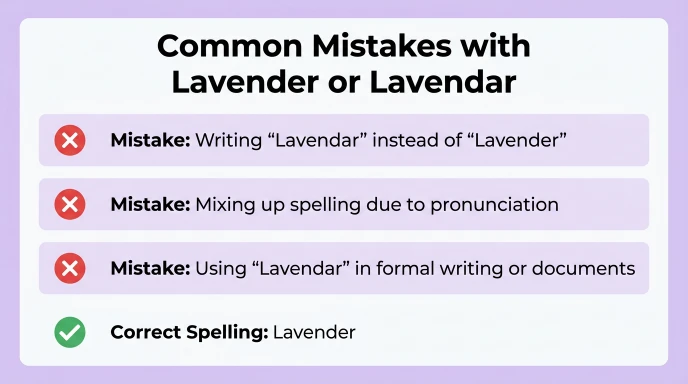
Common Mistakes with Lavender or Lavendar
The Most Common Error
The main mistake is replacing the e with an a.
Incorrect:
lavendar
Correct:
lavender
This mistake can appear in many phrases.
| Incorrect | Correct |
| lavendar flower | lavender flower |
| lavendar plant | lavender plant |
| lavendar oil | lavender oil |
| lavendar scent | lavender scent |
| lavendar color | lavender color |
| lavendar dress | lavender dress |
Other Usage Mistakes
Some people also assume that lavendar is a different type of lavender. It is not.
There is no separate plant called “lavendar” in standard English.
Another mistake is thinking that American English uses lavendar. It does not.
The correct spelling remains lavender regardless of the audience.
An Easy Memory Trick
Try breaking the word into three parts:
lav – en – der
Then put them together:
lav + en + der = lavender
Remember the final part as “der,” not “dar.”
This makes the spelling easier to remember.
Lavender or Lavendar in Everyday Examples
In Emails
When writing an email, use lavender.
Correct:
We would like to order lavender flowers for the event.
Another example:
Please send us the available lavender color options.
Using the correct spelling makes the message clear and professional.
In News and Articles
The word may appear in articles about plants, gardens, fashion, colors, home design, or fragrances.
Example:
The garden is known for its rows of lavender plants.
On Social Media
People often use the word when talking about clothing, flowers, rooms, and colors.
Examples:
This lavender dress is so pretty.
I love the soft lavender shade.
In Formal Writing
Use lavender in:
- School assignments
- Reports
- Business documents
- Product descriptions
- Formal emails
- Articles
- Presentations
Avoid lavendar in formal writing because it is a spelling error.
Lavender or Lavendar: Google Trends & Usage Data
The phrase “lavender or lavendar” shows a clear spelling question. People who type this phrase usually want to confirm which version is correct before using it.
Search interest can change by country, language background, and topic. Someone interested in gardening may search for lavender plant, while someone choosing a color may search for lavender color.
People who are unsure about spelling may search directly for:
lavender or lavendar
This type of search is different from a general search for information about the plant.
| Search Phrase | What the Person May Want |
| lavender | General information |
| lavender plant | Plant information |
| lavender color | Color information |
| lavender meaning | Word meaning |
| lavendar | Spelling check |
| lavender or lavendar | Correct spelling |
Search popularity does not make lavendar a correct spelling. Even if many people type it, the standard form remains lavender.
The important point is to understand the difference between what people search and what is correct English.
Lavender vs Lavendar
The difference between the two forms is very small in appearance but important in writing.
| Feature | Lavender | Lavendar |
| Standard spelling | Yes | No |
| Correct English form | Yes | No |
| Plant meaning | Yes | No |
| Color meaning | Yes | No |
| British English | Yes | No |
| American English | Yes | No |
| Formal writing | Recommended | Avoid |
| Common online searches | Yes | Yes |
The answer is clear: lavender is the correct form.
FAQs
Is it lavender or lavendar?
It’s “lavender.” “Lavendar” is an incorrect spelling that doesn’t appear in any standard English dictionary, it likely comes from confusing the word with others ending in “-ar,” like “calendar.”
Is lavender correct spelling?
Yes, “lavender” is the correct and only accepted spelling in English, if referring to the plant, its scent, or the pale purple color.
Can I name my daughter Lavender?
Yes, Lavender is a legitimate and increasingly popular given name, especially inspired by nature-themed names. It’s used both as a first name and, occasionally, a middle name, and is recognized in many English-speaking countries.
What is lavender called in English?
“Lavender” is already the English name for the plant. It comes from the Latin “lavare,” meaning “to wash,” since the plant was historically used in bathing and perfumes.
What is another name for lavender?
Common alternate names include “English lavender” (referring to a specific species, Lavandula angustifolia) and “true lavender.” In some regions, it’s also loosely associated with terms like “lavandin,” which refers to a hybrid variety.
Is rosemary also called lavender?
No, rosemary and lavender are two distinct plants. While both are aromatic herbs in the mint family often used in gardens and for their fragrance, they have different appearances, scents, and uses, rosemary is more commonly used in cooking, while lavender is prized for its calming scent and use in essential oils.
Conclusion
When choosing between lavender or lavendar, the correct spelling is lavender. The word is spelled with an e before the final r, not an a.
Lavender has two common meanings. It can refer to a fragrant plant with purple flowers, and it can also describe a pale purple color. The word has a long history and developed through older French and Latin forms.
The spelling does not change between British and American English. Both varieties use lavender. The same spelling is also suitable for readers in Canada, Australia, and other English-speaking regions.
The form lavendar is simply a common spelling mistake. It may appear in searches and informal writing, but it should not be treated as a second correct spelling.
Explore More!
Guard or Gaurd: Which Spelling Is Correct?
Ware or Wear: What Is the Difference?

I’m Daniel Carter, a language writer and grammar enthusiast who enjoys making English simple and easy to understand. I write about grammar, spelling, word usage, and common mistakes to help readers use English with more confidence.


1 thought on “Lavender or Lavendar: Which One Is Correct?”