An RV is a broad term for any recreational vehicle, while a motorhome specifically refers to a self-powered RV with living space built into the same vehicle.
Many people use the terms “RV” and “motorhome” interchangeably, but they aren’t exactly the same thing. Understanding the difference can help you choose the right vehicle for your travel needs.
“RV,” short for Recreational Vehicle, is an umbrella term that includes everything from travel trailers and campervans to motorhomes. It covers both towable and motorized vehicles designed for living or camping on the road.
A “motorhome,” on the other hand, is a specific type of RV: one that combines the engine, driving cabin, and living quarters into a single unit. It doesn’t need to be towed, since it can be driven on its own like a regular vehicle.
In this article, we’ll explore the key differences between an RV and a motorhome, their types, pros and cons, and help you decide which one best fits your travel lifestyle.
Quick Answer:
An RV (Recreational Vehicle) is the broad category term used mainly in the U.S. and Canada, while “motorhome” is a more specific term for self-powered RVs, commonly used in the U.K., Europe, and Australia.
Is an RV the same as a motorhome?
Not always. A motorhome is an RV, but an RV is not always a motorhome.
“RV” stands for recreational vehicle. It is a broad category that can include motorhomes as well as towable vehicles such as travel trailers and fifth wheels.
A motorhome is a recreational vehicle that combines the driving area and living area in one vehicle. You can drive it without towing a separate living unit.
| Term | What it means | Has its own engine? |
| RV | Broad term for recreational vehicles | Sometimes |
| Motorhome | Drivable RV with living space | Yes |
| Travel trailer | Towable recreational vehicle | No |
| Fifth wheel | Towable RV designed for a pickup truck | No |
| Campervan | Smaller van-based recreational vehicle | Yes |
For example, a Class A motorhome is an RV, but a travel trailer is also an RV even though it needs another vehicle to tow it.
The Origin of RV or Motorhome
Where does “RV” come from?
RV is short for recreational vehicle. The term is strongly associated with American English and the US recreational vehicle industry.
The history of recreational vehicles goes back much further than the modern abbreviation. People used horse-drawn vehicles and other mobile shelters for travel and leisure before modern motorhomes existed.
The RV Industry Association identifies 1910 as an important benchmark in the development of the modern American RV industry. According to the association, the first motorized campers were built for commercial sale around that time. These early vehicles were very different from today’s RVs, but they helped establish the idea of combining transportation with camping and living space.
The history is more complex than one specific date, though. RV historians point out that recreational vehicles existed in different forms before 1910, including earlier horse-drawn and purpose-built vehicles.
Where does “motorhome” come from?
The word motorhome combines “motor” and “home.” It describes a vehicle designed to provide transportation and a place to live or sleep.
The concept is simple: instead of towing your living space behind a vehicle, the living area is built into the vehicle itself.
Today, motorhomes come in several designs and sizes, from compact campervans to large Class A motorhomes.
British English vs American English Spelling
Is “RV” American English?
Yes. RV is especially common in American English. Oxford describes RV as the abbreviation for “recreational vehicle” and notes that British English may use terms such as camper or camper van.
However, motorhome is not simply a British spelling of RV. They describe overlapping concepts, but “RV” is broader.
In the UK, “motorhome” is a familiar term. In the US, both “RV” and “motorhome” are common, but “RV” is much broader in everyday industry language.
Comparison of regional usage
| Region | Common term | Other terms you may see |
| United States | RV | Motorhome, recreational vehicle, camper |
| United Kingdom | Motorhome | Campervan, camper |
| Australia | Motorhome | Campervan, caravan, RV |
| New Zealand | Motorhome | Campervan, caravan, RV |
| Canada | RV | Motorhome, recreational vehicle |
| Global travel websites | RV / Motorhome | Campervan, camper |
UK motorhome sources also describe RV as an American term and use motorhome for the vehicle itself.
Is “motor home” also correct?
You may see both motorhome and motor home. The closed form “motorhome” is widely used, including in dictionaries and the motorhome industry.
Oxford lists motorhome as a noun and also notes “motor home” as a North American variant.
So, if you are writing for a general audience, motorhome is a clear and widely recognized choice.
Which Spelling Should You Use?
For a US audience
Use RV when discussing recreational vehicles as a broad category.
Use motorhome when you specifically mean a vehicle that is driven and contains living accommodation.
For example:
“We rented an RV for our road trip.”
This could mean a motorhome or another type of recreational vehicle.
If you know the vehicle is a Class C motorhome, write:
“We rented a Class C motorhome.”
That is more precise.
For a UK audience
Motorhome is usually the better choice when referring to a self-propelled vehicle with living space.
“Campervan” is common for smaller van-based vehicles, while “motorhome” can describe larger purpose-built models.
For a global audience
If your website attracts readers from several countries, introduce both terms:
“A motorhome, often called an RV in the United States, is a vehicle with built-in living accommodation.”
After that, you can use the term that best matches your target audience.
This approach is especially useful for travel blogs, rental websites, automotive websites, and international businesses.
Common Mistakes with RV or Motorhome
Mistake 1: Saying every RV is a motorhome
This is the most common mistake.
An RV can include a motorhome, but it can also be a towable trailer or another recreational vehicle.
Better:
“A motorhome is one type of RV.”
Mistake 2: Treating RV as a spelling variant
RV is not another spelling of motorhome.
It is an abbreviation for recreational vehicle.
Mistake 3: Calling a travel trailer a motorhome
A travel trailer is an RV, but it does not have its own engine.
A motorhome is self-propelled.
Mistake 4: Assuming “campervan” always means the same thing
A campervan usually refers to a smaller van-based recreational vehicle. A large Class A motorhome is normally not described as a campervan.
Mistake 5: Using American terminology for every country
If your readers are in Britain, Australia, or New Zealand, “motorhome” or “campervan” may sound more natural than “RV.”
RV or Motorhome in Everyday Examples
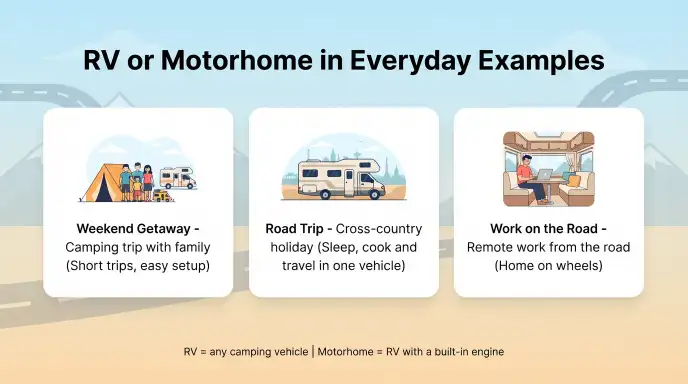
In an email
US audience:
“We are planning to rent an RV for our summer trip.”
UK audience:
“We are planning to hire a motorhome for our summer holiday.”
Both sentences are natural for their intended audiences.
In a news article
A US publication may write:
“The family traveled across the country in an RV.”
A British publication may write:
“The family toured Europe in a motorhome.”
The choice reflects regional vocabulary rather than a major difference in meaning.
On social media
You might see:
“Our RV adventure starts today!”
A UK traveler might post:
“Our motorhome adventure begins today!”
Both communicate the same general idea.
In formal writing
For a technical or professional article, define the term clearly:
“A motorhome is a self-propelled recreational vehicle that combines transportation with living accommodation.”
This is more precise than simply saying “RV.”
RV or Motorhome: Google Trends & Usage Data
Which term is more popular?
Search behavior depends heavily on the country and the context.
In the United States, “RV” is deeply established as the standard broad industry term. US RV organizations, dealers, rental companies, and consumers commonly use the abbreviation.
In the United Kingdom, “motorhome” is more natural when the searcher specifically means a self-propelled vehicle with living accommodation. UK sources commonly describe RV as an American term.
Google Trends should be interpreted carefully here. Trends reports relative search interest, not a fixed number of searches. A high Trends score in one country does not automatically mean that term receives more searches worldwide.
The search intent also changes the result:
- “RV” often relates to the wider recreational vehicle market.
- “Motorhome” usually points to a specific drivable vehicle.
- “Campervan” often suggests a smaller van-based vehicle.
- “RV rental” is strongly associated with US travel searches.
- “Motorhome hire” is a natural UK-style search phrase.
Keyword and usage comparison
| Search term | Likely audience/context | Search intent |
| RV | Mostly US / North American | Broad recreational vehicle |
| Motorhome | UK, US, international | Drivable living vehicle |
| RV motorhome | Mixed/global | Comparison or definition |
| Motorhome rental | International | Renting a motorhome |
| RV rental | Strong US usage | Renting an RV |
| Campervan | UK/international | Smaller van-based vehicle |
RV vs Motorhome
| Feature | RV | Motorhome |
| Meaning | Broad recreational vehicle category | Specific type of RV |
| Engine required | Not always | Yes |
| Can be towed | Some types | No, normally self-propelled |
| Includes trailers | Yes | No |
| Includes campervans | Yes, depending on classification | Often considered a type |
| Common US usage | Very common | Common |
| Common UK usage | Less common | Very common |
The key relationship is simple:
Motorhome → RV
But:
RV → not necessarily motorhome
That distinction can solve most of the confusion around these terms.
Why the Difference Matters When Buying or Renting
Choosing the right vehicle
If you search for an RV rental, you may see several types of vehicles.
If you specifically want a vehicle that you can drive without towing, search for a motorhome rental or a specific motorhome class.
This can save time and help you compare the right products.
Understanding listings
Rental companies may use “RV” as a category while listing motorhomes, campervans, and towable units separately.
Always check the vehicle details rather than relying only on the headline term.
Planning international travel
Terminology matters when traveling between countries.
A US traveler searching for an “RV” in Britain may find more results by searching for motorhome or campervan.
Likewise, a UK traveler looking for a rental in the United States will often see RV rental used by American companies.
FAQs
Is a motorhome the same as an RV?
Not exactly. A motorhome is one specific type of RV, but “RV” itself is a much broader category that covers travel trailers, pop-up campers, and fifth wheels too. So while every motorhome is technically an RV, not every RV is a motorhome.
Do motorhomes have a toilet?
Yes, most motorhomes come equipped with a bathroom that includes a toilet, sink, and often a shower. These are usually compact, self-contained units connected to the vehicle’s freshwater and waste tanks, allowing travelers to stay comfortable even far from campgrounds.
Why is it called an RV?
“RV” stands for Recreational Vehicle, a term that reflects its purpose: a vehicle designed for leisure travel, camping, and road trips rather than daily commuting. The name became popular in North America as these vehicles grew common for long-distance recreational travel.
What do the British call an RV?
In the UK, people typically use the term “motorhome” or “campervan” instead of “RV.” The word “RV” is mostly an American term and isn’t commonly used in everyday British conversation.
Can you sleep anywhere in an RV in the USA?
Not exactly: while RVs offer flexibility, sleeping locations are still regulated. Many campgrounds, rest stops, and even some Walmart parking lots allow overnight RV parking, but local laws and property rules vary widely. It’s always best to check regulations for the specific state or city before parking overnight.
What is a fancy name for an RV?
A more upscale or formal term for an RV is “motorcoach”, often used for luxury Class A motorhomes. Some high-end models are also referred to as “land yachts”: a nod to their size, comfort, and luxury features.
Conclusion:
The choice between RV or motorhome is mainly about terminology, scope, and audience. RV means recreational vehicle and is a broad category. It can include motorhomes, travel trailers, fifth wheels, and other recreational vehicles. A motorhome, on the other hand, is a specific type of RV with its own engine and built-in living space.
The terms also vary by region. American readers commonly use “RV,” while British readers often prefer “motorhome” or “campervan.” Oxford recognizes RV as an abbreviation for recreational vehicle and lists motorhome as a related term.
That small clarification can make your content easier to understand, more useful to readers, and better aligned with the search intent behind terms such as RV or motorhome, RV rental, and motorhome rental.
Key Insights!

My name is James Whitemore, and I am a UK-based English language writer specializing in grammar, vocabulary, punctuation, and writing skills. At Grammer Vivo, I make complex English concepts easy to understand through clear explanations and practical examples, with a focus on both British and American English usage.



1 thought on “RV vs Motorhome: What’s the Difference? ”