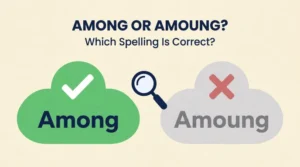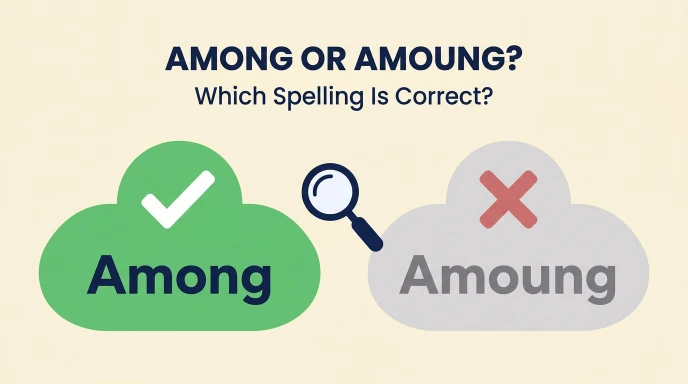
“Among” is the correct spelling, while “amoung” is a common misspelling caused by swapping the “o” and “u” at the end of the word.
One small spelling mistake can make a sentence look less polished. If you have ever wondered if to write among or amoung, the answer is simple: among is the correct spelling, while amoung is a misspelling.
The word among is common in everyday English. We use it when talking about people in a group, things within a collection, or something shared by several people. For example, you might say, “She felt happy among her friends.”
The confusion often happens because English spelling does not always match the way words sound. The ending of among may lead some writers to add an extra letter. Others may have seen the incorrect spelling online and assumed it was acceptable.
This guide explains the meaning of among, its origin, and how to use it correctly. You will also learn the difference between among and between, review common spelling mistakes, and see practical examples from daily conversation, emails, academic writing, and social media.
By the end, you will have a simple way to remember the correct spelling and use it with confidence.
Featured Snippet: Among or Amoung?
Among is the correct English spelling. Amoung is a misspelling and should not be used in standard English writing. Use among when referring to someone or something within a group or collection. For example, “He was sitting among his classmates.” Remember that the correct word contains no letter u after the letter o.
Among or Amoung: Quick Answer
The correct spelling is among.
- Correct: The teacher walked among the students.
- Incorrect: The teacher walked amoung the students.
- Correct: The prize was shared among the winners.
The word among is a preposition. It describes a person or thing in relation to a group.
The spelling amoung is not accepted in standard modern English. If you see it in an essay, email, report, or formal document, correct it to among.
What Does Among Mean?
Among means being in, surrounded by, or included as part of a group or collection. It can also describe something shared or discussed by several people.
Meaning and Definition
Here are the main ways to use among.
1. In the middle of a group
Use among when someone or something is surrounded by several people or things.
Example: The child was playing among the trees.
2. As part of a group
Use it to show that someone belongs to or is included in a group.
Example: She is among the best students in her class.
3. Shared by several people
Use among when something is divided or discussed within a group.
Example: The team shared the responsibility among its members.
4. Within a particular group
Use it when talking about a feeling, opinion, or situation that exists in a group.
Example: There was a sense of excitement among the audience.
Is Among a Preposition?
Yes. Among is a preposition because it shows the relationship between a person or thing and a group.
For example:
- The secret remained among friends.
- The bird disappeared among the leaves.
- The news spread among the workers.
In each sentence, among connects the subject to a group or collection.
The Origin of Among
The word among has a long history in English. It developed from older English forms related to the idea of being in the midst of a group.
Its history is connected to the Old English word gemang, which referred to a crowd, gathering, or mixture. Over time, related forms developed into the modern word among.
English spelling changed over centuries as pronunciation, writing habits, and printing practices developed. Many words that appear unusual today reflect these older changes.
The incorrect form amoung does not represent the standard modern spelling. It is best understood as a spelling error, often caused by confusion about how the word should look.
There is no need to memorize every historical detail to spell the word correctly. The practical rule is simple: write among, not amoung.
British English vs American English
The spelling of among is the same in British English and American English. Unlike words such as colour and color, this word has no standard regional spelling difference.
| British English | American English | Example |
| among | among | The news spread among friends. |
| among | among | She walked among the trees. |
| among | among | The prize was divided among the winners. |
| amoung is incorrect | amoung is incorrect | Use among in both varieties. |
Regional Differences
Writers in the United Kingdom, United States, Canada, Australia, and other English-speaking regions use among.
The word does not change spelling based on the country. It also keeps the same basic meaning across these varieties of English.
Style Guides and Publishing Preferences
Major English dictionaries and established editorial style guides recognize among as the standard spelling.
A publisher may have its own rules for punctuation, capitalization, or other spelling choices. However, these preferences do not make amoung a correct alternative.
If you are writing for a school, university, newspaper, or business, use among.
Which Version Should You Use?
There is only one standard spelling to choose: among.
United States
Use among in school assignments, business documents, reports, emails, and published content.
Example: The decision was popular among employees.
United Kingdom
Use among in both formal and informal writing.
Example: The cottage stood among the hills.
Canada
Canadian English also uses among.
Example: The issue was discussed among committee members.
Australia
Australian English follows the same spelling.
Example: The children ran among the garden plants.
International Writing
If you write for an international audience, choose among. It is understood across major English varieties and avoids unnecessary spelling confusion.
Academic Writing
Use among in essays, research papers, assignments, and reports.
Example: The findings revealed a difference among the three groups.
Always proofread your work before submitting it.
Business Writing
Use among in proposals, presentations, reports, and professional emails.
Example: The new policy was shared among department heads.
In every region and writing style, amoung should be corrected.
Common Mistakes
Spelling errors can happen when a word looks or sounds different from what a writer expects. The following examples show how to avoid common problems.
Mistake 1: Adding an Extra Letter
Incorrect: The money was divided amoung the children.
Correct: The money was divided among the children.
Explanation: The correct spelling does not contain a u after the o.
Memory tip: Remember the short spelling, A-M-O-N-G.
Mistake 2: Using the Incorrect Form in Formal Writing
Incorrect: There was strong support amoung the staff.
Correct: There was strong support among the staff.
Explanation: The incorrect form can make professional writing appear careless.
Memory tip: Run a spelling check before sending important documents.
Mistake 3: Confusing Among With Between
Incorrect: The teacher distributed the books among the two students.
Better in the usual two-person context: The teacher distributed the books between the two students.
Explanation: Traditional grammar often uses between for two clearly distinct people or things and among for groups. However, modern English also allows between for more than two distinct people or things.
Memory tip: Focus on the relationship being described, not only the number of people.
Mistake 4: Assuming Both Spellings Are Acceptable
Incorrect: Both among and amoung are correct.
Correct: Among is the standard spelling.
Explanation: Seeing a spelling error online does not make it an accepted form.
Memory tip: Check a trusted dictionary when a spelling looks uncertain.
Everyday Examples of Among
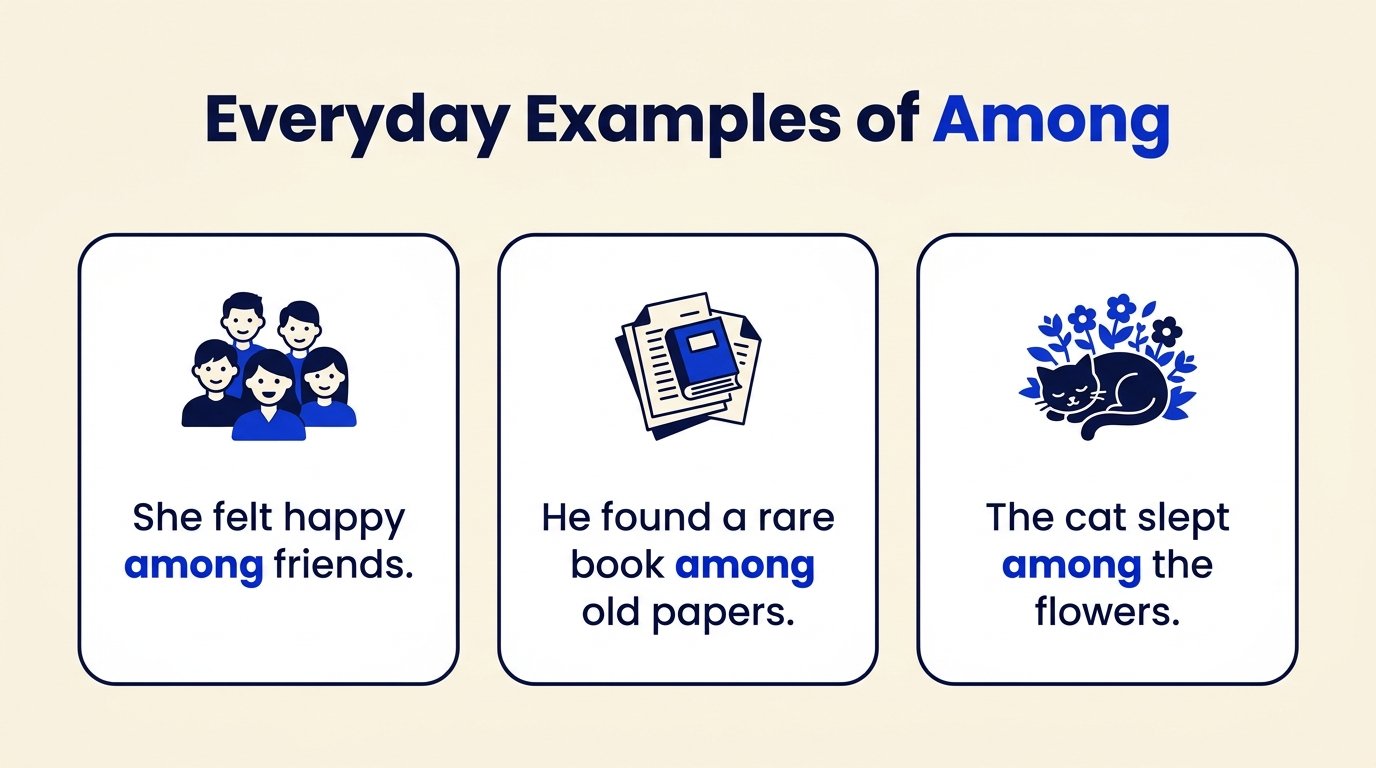
The best way to learn a word is to see it in different situations.
In Emails
“Please share the meeting notes among all team members.”
Here, among shows that the notes should reach the group.
In Business Writing
“The manager distributed the new responsibilities among the department heads.”
The word describes how responsibilities were assigned within a group.
In News Headlines
“New Agreement Reached Among Regional Leaders”
The headline shows that several leaders were involved in the agreement.
In Blog Writing
“These simple habits are popular among people who want to improve their writing.”
The word identifies a group of people who share an interest.
On Social Media
“Feeling lucky to be among such supportive friends.”
Here, among describes being part of a group.
In Academic Writing
“The study examined differences among students from three age groups.”
The word connects the comparison to several groups.
In Daily Conversation
“I found my keys among the papers on the desk.”
This means the keys were located within a collection of papers.
In a Sentence About Opinions
“Among the available options, this one seems the most practical.”
The word introduces a group of choices.
In a Sentence About Sharing
“The cost was divided among the four roommates.”
The word shows how the cost was shared within the group.
Google Trends and Modern Usage
People search for “among or amoung” because the two forms look similar, and they want to confirm which one is correct.
The spelling error may appear in online comments, informal messages, search queries, or user-generated content. A person may also type the wrong form by mistake and then search for the correct spelling.
The standard form, among, is used across British, American, Canadian, Australian, and international English.
Which Spelling Is More Popular?
The correct form is the established spelling in standard English. However, exact search popularity should not be claimed without checking a defined Google Trends region and date range.
Search volume can vary by country, season, and user behavior. A search for the incorrect form does not mean it is accepted English.
Why Does the Confusion Continue?
There are three common reasons:
- English spelling can be difficult to predict from pronunciation.
- Writers sometimes add letters that do not belong in a word.
- Repeated spelling errors online can make an incorrect form look familiar.
The most useful approach is to learn the correct spelling and recognize the mistake when proofreading.
Quick Comparison:
| Version | Meaning | Correct? | Region | Example |
| Among | Within or as part of a group | Yes | Worldwide English | She sat among her friends. |
| Amoung | No standard meaning as a separate modern English word | No | Not standard in any major English variety | Correct it to among. |
This table confirms the key difference: among is the accepted word, while amoung is a spelling error.
Key Takeaways
- Among is the correct spelling.
- Amoung is a misspelling in standard modern English.
- Among means within, surrounded by, or part of a group.
- The word is a preposition.
- British and American English use the same spelling.
- Use among in academic, business, and everyday writing.
- Between and among can overlap in modern usage, depending on context.
- Remember the spelling A-M-O-N-G to avoid adding an extra letter.
FAQs
Which is correct, among or amoung?
“Among” is the correct spelling. “Amoung” does not appear in standard dictionaries such as Merriam-Webster, Cambridge Dictionary, or the Oxford English Dictionary. It is simply a typo, and a very common one, because the “ou” pairing in words like “young” and “country” tricks the eye and the fingers.
How do you spell amoung?
Technically, you don’t, because it is not a word. The correct form is A-M-O-N-G, five letters with the “o” before the “n.” A handy memory trick is to notice that “among” ends the same way as “along” and “belong,” both of which end in “-ong.” Spell checkers in Google Docs and Microsoft Word will usually catch the mistake with a red underline.
How do the British spell “among”?
The spelling is identical in British English: “among.” What differs is preference. British writers often reach for “amongst” as well, which sounds a little more formal or literary, while American writers lean toward the shorter form. Both are accepted in the UK, and neither one is wrong.
Is “among” a real word?
Yes, it is a genuine, long-established English preposition. Its roots go back to Old English, where it began as a phrase meaning “in a crowd” before shortening over the centuries into the word we use today. It appears constantly in everyday writing, from news articles to classic literature.
How to use among correctly?
Use “among” when you are talking about something that is part of a group, or when three or more items or people are involved: “She was the best among all the applicants.” It also fits when the group isn’t counted individually, as in “a quiet moment among friends.” For two clearly separate things, “between” is usually the better fit, such as “the difference between tea and coffee.”
What does “among” mean?
“Among” means in the middle of, surrounded by, or being part of a larger group. It can describe location (“a cottage among the pines”), inclusion (“among the winners”), or sharing (“they divided the prize among themselves”). In short, it places someone or something inside a collection rather than just beside it.
Conclusion
When choosing between among and amoung, the answer is clear: among is the correct spelling. It is a common English preposition that describes being within a group, belonging to a collection, or sharing something among several people.
The word has the same spelling in British, American, Canadian, Australian, and international English. You can use it in everyday conversation, academic assignments, professional emails, reports, and published articles.
The confusion often comes from adding an extra letter or seeing the incorrect form used online. However, amoung is not an accepted alternative in standard modern English. If you spot it while editing, replace it with among.
It is also helpful to understand how among differs from between. Although traditional grammar often links among with groups and between with distinct relationships, the correct choice depends on the context.
For everyday writing, keep one simple rule in mind: spell the word A-M-O-N-G. Check your work when in doubt, and use trusted dictionaries to confirm unfamiliar words.
Remember: among belongs in your writing, but amoung does not. Practice using the correct spelling in a sentence today, and make it a habit in your next email, assignment, or article.

My name is James Whitemore, and I am a UK-based English language writer specializing in grammar, vocabulary, punctuation, and writing skills. At Grammer Vivo, I make complex English concepts easy to understand through clear explanations and practical examples, with a focus on both British and American English usage.