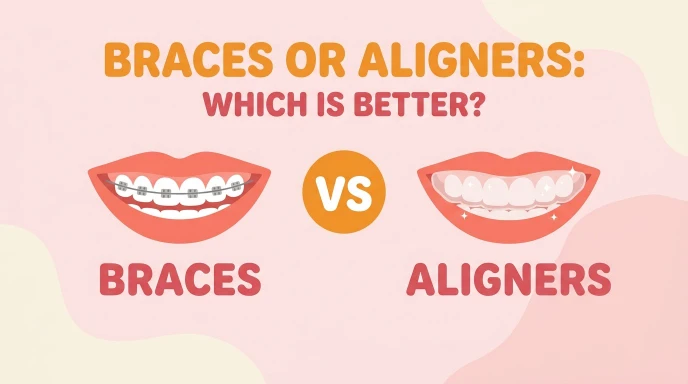
Braces are better for complex bite and alignment problems, while clear aligners are better for mild to moderate cases when you want a nearly invisible, removable option, so the right choice depends on your orthodontist’s assessment.
Choosing between braces or aligners can feel confusing, especially when both options promise straighter teeth. One is fixed to your teeth, while the other uses clear, removable trays. But which option is better for your smile?
The answer depends on your dental needs, bite problems, lifestyle, budget, and willingness to follow your treatment plan. Traditional braces can treat a wide range of orthodontic problems. Clear aligners offer a less noticeable option for many people, especially those with mild to moderate alignment issues.
Both treatments move teeth into better positions over time. However, they differ in appearance, comfort, cleaning, food choices, and daily care. Neither option is automatically better for everyone.
In this guide, you will learn how braces and clear aligners work, their main benefits and drawbacks, their likely costs and treatment times, and the factors that can help you choose. You will also discover common mistakes, practical examples, and questions to ask your orthodontist before starting treatment.
Understanding these differences can help you make a more informed choice and set realistic expectations for your dental health.
Braces or Aligners: The Quick Answer
Braces are often a good choice for complex tooth movements and bite problems because they stay attached to your teeth throughout treatment. Clear aligners are removable, less noticeable, and convenient for people who can wear them as directed, usually for 20 to 22 hours a day. The best option depends on your teeth, bite, treatment goals, and orthodontist’s advice.
Braces or Aligners: Which Option Is Better?
There is no single winner for every patient. The right treatment depends on the problem that needs to be corrected.
Choose braces if you need complex tooth movements, have certain bite problems, or prefer a treatment that does not depend on remembering to wear removable trays.
Consider clear aligners if you want a discreet treatment, have a suitable orthodontic case, and can follow a strict daily wearing schedule.
For example:
- Crowded teeth: Both options may work, depending on how severe the crowding is.
- Complex bite problems: Braces may offer better control for some cases.
- A discreet appearance: Clear aligners are usually less noticeable than traditional metal braces.
An orthodontist can examine your teeth and bite to determine which option is suitable. A dental examination may include photographs, X-rays, scans, or other records.
What Are Braces?
Braces are orthodontic devices that gradually move teeth into better positions. Traditional braces use small brackets attached to the teeth and a wire that applies controlled pressure.
Your orthodontist adjusts the system during regular appointments to guide tooth movement. Some braces use metal brackets, while others use ceramic brackets that blend more closely with tooth color.
Types of Braces
- Metal braces: Strong, widely used, and suitable for many orthodontic problems.
- Ceramic braces: Use tooth-colored or clear brackets for a less noticeable appearance.
- Lingual braces: Attach to the back surfaces of the teeth, making them harder to see from the front.
Benefits of Braces
Braces remain attached to your teeth, so you do not need to remember to put them back in after meals. They can also provide precise control over many types of tooth movement.
Other benefits include:
- Suitable for a wide range of orthodontic cases.
- No need to remove the appliance before eating.
- No risk of forgetting to wear trays.
- Different styles are available to suit individual needs.
Drawbacks of Braces
Braces are visible, especially when they use metal brackets. Food can collect around the brackets and wires, making brushing and flossing more challenging.
You may also need to avoid hard, sticky, and chewy foods that can damage the appliance. Some people experience temporary soreness after braces are fitted or adjusted.
What Are Clear Aligners?
Clear aligners are custom-made plastic trays that fit over your teeth. Each tray applies gentle pressure to move selected teeth gradually.
You usually receive a series of trays and change them according to your orthodontist’s instructions. The exact schedule depends on your treatment plan.
Unlike fixed braces, clear aligners can be removed for meals, drinks other than water, brushing, and flossing.
Benefits of Clear Aligners
Clear aligners are popular with adults and teenagers who want a discreet orthodontic option.
Their main benefits include:
- Clear trays that are difficult to notice from a distance.
- Easy removal during meals.
- Convenient brushing and flossing.
- No brackets or wires to rub against the inside of the mouth.
- Fewer food restrictions because you remove the trays before eating.
Drawbacks of Clear Aligners
Aligners require discipline. They generally need to be worn for around 20 to 22 hours a day, or for the duration prescribed by your orthodontist.
Removing them too often can slow progress. Forgetting to wear them can also affect how well the next tray fits.
Other drawbacks include:
- Trays can be lost or damaged.
- You must remove them before eating.
- You need to clean your teeth before putting them back in.
- Some complex tooth movements may be better managed with fixed braces.
- Attachments or additional orthodontic appliances may still be necessary.
Clear aligners are not suitable for every patient. A professional assessment is essential before choosing treatment.
Braces vs. Aligners: Main Differences
The table below compares the main features of both treatments.
| Feature | Traditional Braces | Clear Aligners |
| Appearance | Visible brackets and wires | Clear, less noticeable trays |
| Removable | No | Yes |
| Eating | Some foods should be avoided | Remove trays before meals |
| Cleaning teeth | Requires careful cleaning around brackets | Easier access to teeth |
| Daily discipline | Appliance stays in place | Requires consistent wear |
| Complex cases | Suitable for many complex problems | Suitability depends on the case |
| Comfort | May cause rubbing or soreness | May cause pressure with new trays |
| Lost appliance risk | Lower during normal use | Trays can be misplaced |
| Appointments | Regular adjustments and checks | Progress checks and tray changes |
| Retainers after treatment | Usually needed | Usually needed |
Both treatments can work well when correctly planned and monitored. The important question is not which appliance looks better, but which one can safely achieve your treatment goals.
Braces vs. Aligners: Treatment Time and Cost
Treatment time and price vary from person to person. The severity of the problem, the movements required, the type of appliance, and your response to treatment all matter.
How Long Does Treatment Take?
Many orthodontic treatments take around one to two and a half years, although simpler cases may take less time and complex cases may take longer.
Clear aligners are sometimes used for shorter treatment plans, but they are not always faster than braces. If you do not wear your trays as prescribed, treatment may take longer.
Braces also require regular appointments. Your orthodontist will monitor progress and make adjustments when needed.
Which Costs More?
There is no universal price difference between braces and aligners.
The total cost may depend on:
- The complexity of your dental problem.
- The type of braces or aligner system.
- Your location and the provider’s fees.
- The length of treatment.
- The cost of scans, appointments, retainers, and follow-up care.
Metal braces may be a more affordable option in some clinics. Ceramic braces and clear aligners may cost more, but prices vary widely.
Ask for a written treatment estimate that explains what is included. A low starting price may not cover retainers, extra appointments, or refinements.
Which Version Should You Choose?
The best choice depends on your priorities and your orthodontic needs.
Choose Braces If:
- Your case needs complex tooth movements.
- You have a bite problem that may respond better to fixed treatment.
- You may struggle to wear removable trays consistently.
- You prefer not to remove an appliance throughout the day.
- Your orthodontist recommends fixed treatment for better control.
Choose Clear Aligners If:
- You want a less noticeable option.
- Your teeth and bite are suitable for aligner treatment.
- You can wear trays for the prescribed number of hours.
- You prefer to remove your appliance when eating and brushing.
- You are comfortable keeping track of your trays and cleaning routine.
What About Teenagers and Adults?
Both teenagers and adults can receive orthodontic treatment. Age alone does not determine the best option.
Teenagers who may forget to wear removable trays might find fixed braces easier to manage. Responsible teenagers may be suitable for aligners, depending on their dental development and treatment needs.
Adults often prefer aligners because they are discreet. However, adults with complex bite problems may still benefit more from braces.
Your orthodontist should base the recommendation on a complete examination, not age or appearance alone.
Common Mistakes When Choosing Braces or Aligners
Mistake 1: Choosing Only by Appearance
Incorrect approach: Choosing clear aligners simply because they are less visible.
Better approach: Check if they can correct your specific dental problem.
Why it matters: An attractive appliance is not useful if it cannot achieve the required tooth movements.
Mistake 2: Assuming Aligners Are Always Faster
Incorrect claim: Clear aligners always straighten teeth faster than braces.
Correct understanding: Treatment time depends on the case, the treatment plan, and patient cooperation.
Memory tip: The appliance is only one part of the treatment.
Mistake 3: Ignoring Daily Wear Time
Incorrect habit: Removing aligners for long periods throughout the day.
Better habit: Wear them for the number of hours prescribed by your orthodontist.
Why it matters: Teeth need consistent pressure for planned movement.
Mistake 4: Thinking Treatment Ends When Teeth Look Straight
Incorrect belief: Retainers are optional once treatment is complete.
Correct understanding: Teeth can shift after either treatment. Retainers help maintain the result.
Memory tip: Straighten first, retain afterward.
Mistake 5: Buying Treatment Without a Proper Assessment
Incorrect approach: Starting treatment without a professional examination.
Better approach: Have your teeth, gums, and bite assessed by a qualified dental professional.
Why it matters: Some dental problems need treatment before orthodontic movement begins.
Everyday Examples: Braces or Aligners in Real Life
Your routine can help you understand which option may fit your needs.
In School or College
A student who prefers a fixed appliance and does not want to track removable trays may find braces more convenient. Another student who values a discreet appearance and follows routines carefully may prefer aligners.
At Work
An adult who gives presentations may prefer the subtle appearance of clear aligners. However, frequent meals, travel, and a busy schedule can make tray management harder.
During Meals
People with braces need to avoid certain hard or sticky foods. People with aligners remove their trays before eating and should clean their teeth before reinserting them.
During Oral Hygiene
Braces need careful brushing around brackets and wires. Aligners make brushing and flossing easier because the trays can be removed, but the trays also need regular cleaning.
During Sports and Social Activities
Both treatments can fit an active lifestyle. People who play contact sports should ask their orthodontist about suitable mouth protection.
In Everyday Conversation
If someone asks, “Are braces or aligners better?” a useful answer is: “Both can straighten teeth, but the best option depends on your bite, treatment needs, and daily habits.”
Modern Trends and Search Interest
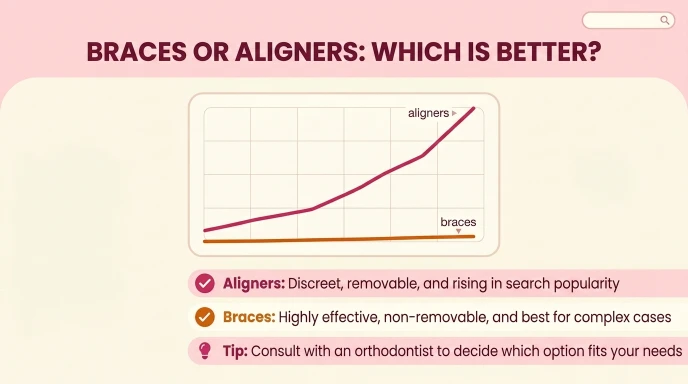
Many people search for braces or aligners because they want a straighter smile without disrupting their daily routine. Appearance, comfort, treatment costs, and convenience are common concerns.
Clear aligners have attracted attention because they are removable and less noticeable. Traditional braces remain important because they can treat a broad range of orthodontic problems.
Search interest may vary by country, age group, treatment costs, and local access to orthodontic care. Without checking a defined Google Trends region and time period, it would be misleading to claim that one option is searched for more often or provide exact popularity figures.
People also confuse clear aligners with retainers. Aligners are designed to move teeth during active treatment. Retainers are mainly used afterward to help keep teeth in their new positions.
The most useful search is not simply “Which is more popular?” It is “Which treatment is suitable for my teeth and bite?”
Quick Comparison:
| Version | Main Purpose | Suitable For | Key Limitation |
| Metal braces | Move and align teeth | Many mild to complex cases | Visible and harder to clean |
| Ceramic braces | Move and align teeth discreetly | Suitable cases needing fixed treatment | May be more costly |
| Lingual braces | Fixed treatment from behind the teeth | Selected cases | Can be more difficult to adjust to |
| Clear aligners | Gradual tooth movement with removable trays | Many mild to moderate cases and selected others | Requires consistent wear |
Key Takeaways
- Braces and clear aligners can both straighten teeth.
- Braces may be better for certain complex tooth movements and bite problems.
- Clear aligners are less noticeable and removable.
- Aligners work best when worn as prescribed.
- Braces require careful cleaning and some food restrictions.
- Treatment time and price depend on your individual case.
- Most patients need retainers after active treatment.
- An orthodontist can help you choose the safest and most suitable option.
FAQs
Are braces more effective than aligners?
For complex cases, yes. One study found that aligners might lengthen treatment for complex cases compared to fixed appliances, though they may treat mild cases without extractions faster. For straightforward crowding or spacing, the gap narrows: a systematic review found fixed appliances and aligners had comparable overall efficacy in moving teeth. Severe bite problems, rotated teeth, and jaw discrepancies still tend to favor traditional braces, because the orthodontist controls every force instead of relying on how consistently you wear trays.
Will teeth move 10 years after braces?
They can, and often do, especially if retainers are skipped. Dr. Myron Guymon, president of the American Association of Orthodontists at the time, notes that teeth keep changing over a lifetime, so relapse is possible if you stop wearing your retainer, and even people who never had orthodontics can see movement with age. Long-term research tracking patients for 10 to 20 years shows that those who stop using retainers eventually experience some degree of relapse. A nightly retainer, or a bonded wire behind the lower front teeth, is the simplest insurance for your results.
Can I kiss with aligners on?
Technically yes, since the smooth plastic is thin and rarely noticeable, but most people find it awkward. Aligners are typically worn about 22 hours a day, which leaves a couple of hours for meals, brushing, and moments like a date night. Slip them out into their case beforehand, then brush before putting them back so food and bacteria are not trapped against your teeth. Never wrap them in a napkin, because that is how most trays get thrown away.
Is 20 too late for braces?
Not at all. Twenty is a very common age to start, and age is rarely the limiting factor. The AAO estimates that roughly one in three orthodontic patients is an adult. What matters far more is healthy gums and bone support, so an exam with an orthodontist is the best first step. Adults also have more choices today, including clear ceramic brackets, lingual braces behind the teeth, and aligners.
Do braces make teeth 100% straight?
Braces aim for a well-aligned smile and a healthy, functional bite, but “perfect” depends on your starting point, jaw structure, and how well you follow instructions. Tiny imperfections, like slight differences in tooth height or a minor rotation, can remain, and these are usually refined during the final months. The straightness you see on debanding day is only guaranteed to last if you commit to retainers.
Can braces take 7 years?
It is extremely rare. Most treatment finishes in roughly one to three years. Treatment time depends on how much movement is needed, with small changes taking a few months and more involved cases taking longer. Cases that drag on for many years usually involve missed appointments, repeated broken brackets, poor elastic wear, or complicated jaw problems. If your plan keeps getting extended, ask your orthodontist for a clear timeline and the exact reason for each delay.
Conclusion
Choosing between braces or aligners starts with understanding your dental needs. Both options can improve tooth alignment, but they work differently and suit different situations.
Braces stay fixed to your teeth and offer control over many types of tooth movement. They may be the better choice for certain complex cases and for people who do not want to manage removable trays. Clear aligners are less noticeable, make brushing easier, and allow you to eat without the trays in place. However, they require consistent wear and may not suit every bite problem.
Cost, comfort, and treatment time matter, but they should not be the only factors in your decision. The most important step is to get a professional assessment and understand the expected results, possible limitations, and full treatment costs.
Ask your orthodontist to explain the options available for your particular teeth. Make sure you understand the daily care routine and the need for retainers after treatment.
The best treatment is not simply the one that looks better. It is the one that safely meets your dental needs and fits your daily life.
Take the first step by arranging an orthodontic assessment and discussing both options before making your decision.
Find Out More!

My name is James Whitemore, and I am a UK-based English language writer specializing in grammar, vocabulary, punctuation, and writing skills. At Grammer Vivo, I make complex English concepts easy to understand through clear explanations and practical examples, with a focus on both British and American English usage.




2 thoughts on “Braces or Aligners: Which Is Better?”