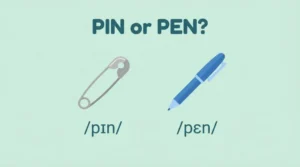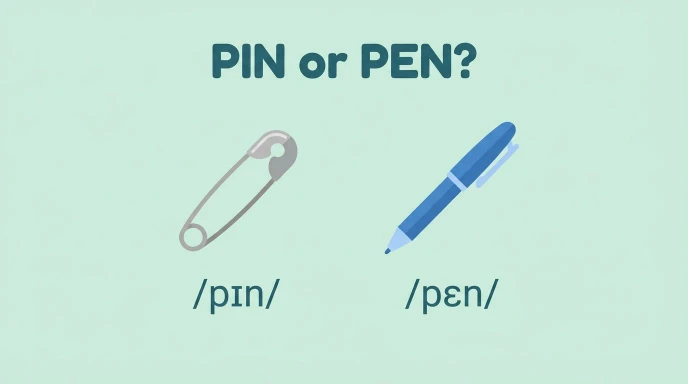
“Pin” and “pen” are two different words: a pin is a thin metal fastener (/pɪn/), while a pen is a writing tool with ink (/pɛn/), though in some Southern US accents both sound alike.
Many English learners get confused between “pin” and “pen” because the two words look almost the same and differ by only one vowel. This small difference changes the meaning completely, so knowing which one to use matters.
The word “pin” refers to a small, sharp piece of metal used to fasten things together, or to a secret code like a PIN number. The word “pen,” on the other hand, means a tool used for writing or drawing with ink, and it can also mean an enclosed space for animals.
Pronunciation is where most people struggle. “Pin” uses a short “i” sound like in “sit,” while “pen” uses a short “e” sound like in “bed,” but some American accents blend them into one sound, known as the pin-pen merger.
In this guide, you will learn the exact meaning, correct spelling, and clear pronunciation of both words, along with simple examples and tips to remember the difference. By the end, you will be able to use “pin” and “pen” with full confidence in writing and speaking.
Quick Answer:
“Pin” and “pen” are two different words: a pin is a thin metal fastener (/pɪn/, short “i” sound), while a pen is a writing tool with ink (/pɛn/, short “e” sound), though in some Southern US accents both sound alike, known as the “pin-pen merger.”
The Short Answer: Pin or Pen
These are two different English words with different meanings. A pin is a small, pointed object used to fasten or hold things together. A pen is a tool used for writing or drawing with ink.
- Pin: Please use a pin to attach the badge to your shirt.
- Pen: Please use a pen to sign your name.
The words have different vowel sounds in many English accents, but they may sound alike in some regional accents. The correct spelling depends on what you mean.
Pin or Pen: Quick Answer
Use pin when you mean a small, pointed object. Use pen when you mean a tool for writing with ink.
Here are three easy examples:
- I found a pin on the floor.
- Can I borrow your pen?
- She used a pin to attach the note to the board.
A simple memory trick is to connect pen with paper and writing. Connect pin with pointed and fastening.
What Does Pin Mean?
A pin is a small, thin object that often has a sharp point. It is used to fasten, attach, or hold things in place.
Pins come in different shapes and sizes. Some are sharp and made of metal. Others are flat or decorative.
Common meanings of pin
- Safety pin: A metal pin with a clasp that helps keep its point covered.
- Drawing pin: A small object used to attach paper to a wall or board.
- Hairpin: An object used to hold hair in place.
- Map pin: A marker used to show a location on a map.
- PIN: An abbreviation for personal identification number, a code used to verify identity.
Examples of pin in sentences
- She used a pin to attach the photograph to the board.
- I put a pin in the map to mark the city.
- He entered his PIN at the cash machine.
- My sister wore a decorative pin on her jacket.
Notice that pin does not always refer to a sharp object. In technology and banking, PIN usually means personal identification number.
What Does Pen Mean?
A pen is a writing instrument that uses ink to form letters, numbers, and pictures on a surface.
Pens are common in schools, offices, homes, and many other places. They come in different types, such as ballpoint pens, fountain pens, gel pens, and rollerball pens.
Common meanings of pen
- Ballpoint pen: A pen that uses a small rotating ball to transfer ink to paper.
- Fountain pen: A pen that delivers ink through a nib.
- Gel pen: A pen that uses gel-based ink.
- Pen name: A false or chosen name used by a writer.
- Animal pen: An enclosed area used to keep animals.
Examples of pen in sentences
- I use a blue pen to complete my homework.
- Please sign the form with a black pen.
- The author writes under a pen name.
- The farmer put the sheep in a pen.
The word pen can also be a verb. To pen a letter means to write a letter. In another context, to pen someone in means to keep them within a limited space.
The Origin of Pin and Pen
The words pin and pen have different histories, even though their spellings differ by only one letter.
Origin of pin
The English word pin comes through Old English and has Germanic roots. It has long referred to a small object used to fasten or secure something.
Over time, its uses expanded. Today, the word can describe physical objects, location markers, and digital or security-related codes.
For example, people can pin a note to a board, pin a location on a digital map, or enter a personal identification number.
Origin of pen
The word pen comes from the Latin word penna, meaning “feather.” Early writing instruments were often made from feathers, which were cut to form a writing point.
As writing tools changed, the word continued to refer to instruments used for writing. Modern pens use different materials and ink systems, but the basic purpose remains the same.
The word also developed other meanings, including an enclosure for animals and the verb meaning to write.
Why are pin and pen so similar?
The words share several letters, but they developed from different historical sources. Their similar appearance does not mean they have the same meaning or origin.
The key difference is simple:
- Pin: A word associated with fastening, pointing, marking, or identification.
- Pen: A word associated with writing, ink, and, in some contexts, an enclosure.
British English vs American English
The spelling of pin and pen is the same in British and American English. The main difference is how people pronounce the vowel sounds in these words.
In many accents, pin has the vowel sound found in sit, while pen has the vowel sound found in bed. However, some regional accents pronounce them more similarly.
| Feature | British English | American English | Example |
| Spelling | Pin, pen | Pin, pen | Both spellings are standard |
| Vowel in pin | Usually like the vowel in sit | Usually like the vowel in sit | Pin |
| Vowel in pen | Usually like the vowel in bed | Usually like the vowel in bed | Pen |
| Regional variation | Accents vary by region | Accents vary by region | Some Southern US speakers merge the sounds |
| Meaning | Depends on the word | Depends on the word | A pin fastens; a pen writes |
What is the pin-pen merger?
The pin-pen merger is a feature of some English accents in which the vowels in pin and pen sound the same or nearly the same before the letter n.
It is especially associated with parts of the American South, although the exact pattern varies among speakers.
For example, a speaker with this feature may pronounce pin and pen almost identically. Listeners may need to use the sentence to understand which word the speaker means.
This does not change the spelling or meaning of either word. It is simply a difference in regional pronunciation.
Which pronunciation should English learners use?
If you are learning English, practise keeping the vowel sounds distinct:
- Pin: Similar to the vowel sound in sit.
- Pen: Similar to the vowel sound in bed.
You do not need to copy every regional accent. Focus on clear speech and consistent pronunciation. If you are studying for an exam or following a pronunciation course, use the accent model recommended by your teacher.
Which Version Should You Use?
Unlike words such as colour and color, pin and pen are not British and American spelling variants. Both words are correct in both varieties of English. Your choice depends on meaning, not location.
| Audience or context | Recommendation | Example |
| United States | Use pin for a fastening object and pen for writing | I need a pen. |
| United Kingdom | Use the same spelling and meaning distinction | Put a pin on the board. |
| Canada | Use the standard spellings | She borrowed my pen. |
| Australia | Use the standard spellings | I found a pin. |
| International writing | Choose the word that matches your intended meaning | Please bring a pen. |
| Academic writing | Use precise vocabulary and explain PIN if needed | Participants entered a personal identification number. |
| Business writing | Choose the word that fits the task | Please sign using a blue pen. |
In formal writing, do not replace one word with the other simply because they sound similar. Always check the intended meaning.
Common Mistakes
English learners sometimes confuse pin and pen because of their similar sounds. These mistakes are easy to fix once you focus on meaning and context.
| Incorrect example | Correct example | Explanation |
| Please give me a pin to write my name. | Please give me a pen to write my name. | A pen is used for writing. |
| Use a pen to attach this paper to the wall. | Use a pin to attach this paper to the wall. | A pin can hold paper in place. |
| I forgot my pin at home, so I cannot write. | I forgot my pen at home, so I cannot write. | A writing tool is needed. |
| She put a pen on the map to mark the city. | She put a pin on the map to mark the city. | A map pin marks a location. |
The first two sentences are incorrect for the intended meanings. However, a pen could mark a map by drawing on it, so the exact context matters.
Three mistakes to avoid
1. Choosing a word based only on sound
Some speakers pronounce pin and pen almost alike. Do not rely on sound alone when the meaning is unclear.
2. Assuming one word is British and the other is American
This is false. Both words are standard in British and American English.
3. Confusing PIN with pen
A PIN is a code, often made of numbers. A pen is a writing instrument. They are not interchangeable.
A simple memory tip
Remember these two phrases:
- Pen = paper and writing.
- Pin = point and fastening.
When you are unsure, ask yourself what the object does. If you use it to write with ink, choose pen. If you use it to fasten or mark something, choose pin.
Everyday Examples of Pin and Pen
The best way to remember the difference is to see both words in real situations.
1. In emails
- “Could you please bring a pen to the meeting?”
- “I have attached the printed schedule with a pin to the noticeboard.”
The first sentence refers to writing. The second describes fastening a printed schedule.
2. In business writing
- “Please sign the agreement using a black pen.”
- “Use a map pin to identify the office location.”
These examples show how each word serves a different purpose in a workplace.
3. In news headlines
- “Police Identify Location Using a Digital Map Pin”
- “Students Asked to Bring a Pen to the Examination”
Headlines often use short, direct wording. The surrounding topic helps readers understand the intended meaning.
4. In blogs
- “How to Choose the Best Pen for Everyday Writing”
- “How to Use a Pin to Display Photos on a Board”
Both words can appear in educational articles, product guides, and how-to content.
5. On social media
- “Can someone lend me a pen?”
- “I pinned the location so everyone can find the café.”
In the second example, pinned is the past tense of the verb pin. It can refer to marking a location or keeping a post at the top of a page.
6. In academic writing
- “Students must write their answers in blue or black ink using a pen.”
- “The researcher marked each sample location with a pin.”
Academic writing requires clear and accurate word choice. If PIN means personal identification number, write the full term on first use when the audience may not know the abbreviation.
7. In daily conversation
- “Do you have a pen I can borrow?”
- “Can you give me a pin to hold this fabric together?”
- “I forgot my PIN and cannot access my account.”
These short sentences are useful for practising the difference in everyday English.
Google Trends and Modern Usage

People search for pin or pen for several reasons. Some want to know which word is correct. Others want help with pronunciation, spelling, or the difference between the two words in American and British English.
The confusion often comes from the fact that pin and pen differ by only one letter. In some accents, their vowel sounds also become very similar.
Regional popularity and pronunciation
The words are used across English-speaking countries, but their pronunciation varies from place to place.
- In many British accents, the vowel sounds are distinct.
- In many American accents, the sounds are also distinct.
- In some Southern American accents, the vowels may merge before the letter n.
These are broad patterns, not rules that apply to every speaker.
What do Google Trends searches tell us?
Google Trends can help compare search interest over time and across regions. However, no verified trend figures are provided here, so it would be misleading to claim that one word is searched more often than the other.
Search interest can also reflect different meanings. For example, searches for PIN may relate to banking or account security, while searches for pen may relate to writing tools.
For learners, the most useful approach is to study the meaning, listen to different accents, and practise saying both words in complete sentences.
Quick Comparison:
| Version | Meaning | Correct? | Region | Example |
| Pin | A small object used to fasten something | Yes | Worldwide | I used a pin to attach the paper. |
| Pen | A tool used to write with ink | Yes | Worldwide | I wrote the answer with a pen. |
| PIN | Personal identification number | Yes | Worldwide | Enter your PIN to access the account. |
| Pin | A marker for a location or item | Yes | Worldwide | I dropped a pin on the map. |
| Pen | An enclosed area for animals | Yes | Worldwide | The sheep are in the pen. |
The table shows why context matters. Both pin and pen have more than one meaning, but their meanings are not interchangeable.
Key Takeaways
- Pin and pen are different words with different meanings.
- A pin is commonly used to fasten, attach, or mark something.
- A pen is commonly used to write or draw with ink.
- Both words use the same spelling in British and American English.
- In many accents, pin rhymes with tin, while pen rhymes with ten.
- Some regional accents pronounce the two words almost identically.
- PIN is an abbreviation for personal identification number.
- Remember pen = writing and pin = pointing or fastening to avoid common mistakes.
FAQs:
1. What is the difference between pin and pen?
A pin is a small object used to fasten or mark something. A pen is a writing tool that uses ink. For example, you use a pin to attach a photograph to a board and a pen to write a message. Although the words look similar, they have different meanings and are not interchangeable.
2. Is it pin or pen for writing?
The correct word is pen when you mean a tool used for writing with ink. For example, “I need a pen to complete this form.” A pin is used for fastening or marking things. Remember that a pen writes words, while a pin can hold paper or fabric in place.
3. Do pin and pen sound the same?
Not in every English accent. In many accents, pin has the vowel sound in sit, while pen has the vowel sound in bed. In some Southern American accents, these vowels sound alike before the letter n. This feature is called the pin-pen merger.
4. Is pin or pen the correct spelling in American English?
Both spellings are correct in American English. The right choice depends on the meaning. Use pin for a fastening object or a location marker. Use pen for a writing instrument. Neither spelling is an American-only version, and the same distinction applies in British English.
5. Is pin or pen British English?
Both pin and pen are standard British English words. They have different meanings, although pronunciation varies among British speakers. You should not choose one based on if you are writing for a British or American audience. Choose the word that expresses the meaning you intend.
6. Can pin and pen have other meanings?
Yes. A pin can be a map marker or part of a security code when used in the abbreviation PIN. A pen can also mean an enclosure for animals, and to pen can mean to write something. Context helps readers and listeners understand which meaning is intended.
Conclusion
The difference between pin or pen is simple once you understand what each word means. A pin is commonly used to fasten, attach, or mark something. A pen is a tool used to write with ink. Both words are correct in British and American English, so the choice depends on meaning rather than region.
Pronunciation can make these words confusing. In many English accents, pin and pen have different vowel sounds. However, some speakers, especially in parts of the American South, pronounce them almost alike. This is a natural feature of regional speech, not a spelling mistake.
If you are learning English, practise both words in short sentences. Say “I need a pen to write” and “I need a pin to attach this note.” Listen for the vowel sounds, but always use context to confirm the meaning.
For writing, remember that spelling matters even when two words sound similar. For speaking, clear pronunciation and useful context help others understand you.
The easiest rule to remember is this: use a pen to write and a pin to fasten. Practise this simple distinction in everyday conversation, and you will be less likely to confuse the two words.

My name is James Whitemore, and I am a UK-based English language writer specializing in grammar, vocabulary, punctuation, and writing skills. At Grammer Vivo, I make complex English concepts easy to understand through clear explanations and practical examples, with a focus on both British and American English usage.