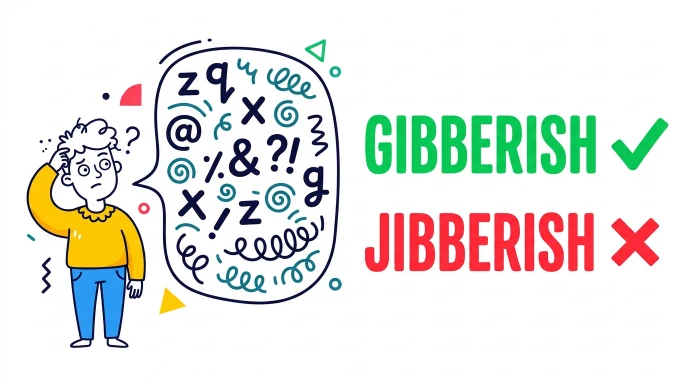
Gibberish is the correct spelling. “Jibberish” is a common misspelling, so if you want to write it correctly, always use “gibberish” with a “G” at the start.
Gibberish refers to speech or writing that makes no sense, such as meaningless sounds, random words, or confusing nonsense. For example, if someone speaks so fast or unclearly that you can’t understand them, you might say they are talking gibberish. The word is used in everyday conversation, in books, and on social media.
Many people confuse the two spellings because “gibberish” is often pronounced with a soft “j” sound, like “jibberish.” That is why the wrong spelling appears so often in online searches. However, dictionaries such as Merriam-Webster and Oxford list “gibberish” as the standard form, and “jibberish” is considered a variant at best or simply an error.
The word’s exact origin is uncertain, but it is believed to have formed in the 16th century, possibly from the word “gibber,” meaning to chatter rapidly and unintelligibly. “Gibber” is probably imitative of the sounds of rapid, meaningless speech. Over time, “gibberish” became the standard word for anything that lacks clear meaning.
To remember the right spelling, think of “gibber” as the root and add “-ish” at the end. If you are writing an article, essay, or message, using “gibberish” will keep your writing accurate and professional. In short, the correct spelling is gibberish, and its meaning is meaningless or unintelligible speech or writing.
Featured Snippet: Gibberish or Jibberish?
Gibberish is the correct standard spelling in both British and American English. It means words, sounds, or writing that are difficult to understand or seem meaningless. Jibberish is a common misspelling and should generally be avoided in formal writing.
For example: “The message looked like gibberish because I could not understand it.
Gibberish or Jibberish: Quick Answer
The correct spelling is gibberish.
- Gibberish: Correct standard spelling.
- Jibberish: Common misspelling.
- Meaning: Speech, writing, or sounds that are unclear or meaningless.
- Usage: Everyday conversations, schoolwork, emails, and professional writing.
Examples:
- “The computer displayed gibberish on the screen.”
- “I was so tired that my words sounded like gibberish.”
- “The instructions were gibberish to me.”
Remember to use gibberish whenever you want to describe something that makes little or no sense.
What Does Gibberish Mean?
Gibberish is a noun that describes speech, writing, or other communication that seems meaningless or is difficult to understand.
People often use the word when someone speaks unclearly, writes confusing sentences, or uses words that listeners cannot understand.
Simple Definition
Gibberish means language or sounds that do not make sense to the person hearing or reading them.
For example:
- “This paragraph is gibberish.” This means the paragraph is difficult to understand.
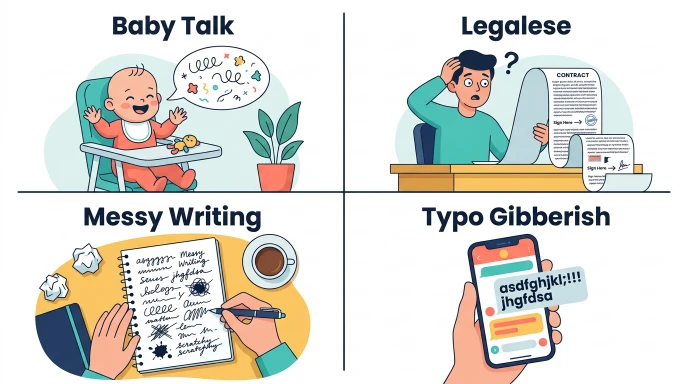
- “The baby made funny gibberish sounds.” This describes sounds that do not form understandable words.
- “The file turned into gibberish.” This means the text became unreadable or corrupted.
Is Gibberish Always Meaningless?
Not necessarily. Sometimes, people call something gibberish because they do not understand it, even if it has meaning to someone else.
For example, a technical report may look like gibberish to a beginner but make perfect sense to an expert.
Similarly, a person may describe an unfamiliar language as gibberish because they cannot understand it. However, that does not mean the language itself is meaningless.
The Origin of Gibberish
The exact origin of gibberish is uncertain. The word has been used in English for several centuries, with historical records dating back to the 16th century.
One proposed explanation connects it to gibber, a word associated with speaking rapidly or indistinctly. Another theory links it to the name of the medieval alchemist Geber, whose technical writings might have seemed mysterious to outsiders. However, this connection is uncertain and should not be treated as established fact.
Over time, gibberish developed into a common word for speech or writing that seems meaningless or cannot be understood.
The spelling jibberish likely developed because the initial sound of the correct word can be confused with the letter J by some writers. Nevertheless, the standard spelling remains gibberish.
British English vs American English
There is no standard British-versus-American spelling difference for this word. Both varieties use gibberish.
| Feature | British English | American English |
| Correct spelling | Gibberish | Gibberish |
| Common misspelling | Jibberish | Jibberish |
| Part of speech | Noun | Noun |
| Meaning | Unclear or meaningless language | Unclear or meaningless language |
| Example | “His notes were gibberish.” | “His notes were gibberish.” |
Which Spelling Should You Use?
Use gibberish in all these situations:
- United States: Use gibberish in school, work, and everyday writing.
- United Kingdom: Use gibberish in British English.
- Canada: Use gibberish in standard Canadian English.
- Australia: Use gibberish in Australian English.
- International writing: Choose gibberish for clear, standard usage.
- Academic writing: Use gibberish when describing unclear or meaningless language.
- Business writing: Use gibberish when explaining confusing messages or unreadable information.
You do not need to change the spelling based on your audience’s country.
Common Mistakes When Using Gibberish
The most common mistake is writing jibberish instead of gibberish. Other mistakes involve using the word in situations where a more precise term would be better.
| Incorrect or less suitable | Correct or better choice | Explanation |
| “This is jibberish.” | “This is gibberish.” | Use the standard spelling. |
| “The report is gibberish” when it contains many difficult terms | “The report is technical and difficult to understand.” | Be more precise when the writing has a clear meaning. |
| “That foreign language is gibberish.” | “I cannot understand that language.” | An unfamiliar language is not meaningless simply because you do not understand it. |
| “He wrote gibberish” when the text contains random symbols | “He wrote random symbols.” | Describe the actual problem when possible. |
Easy Memory Tip
Remember this simple rule: Gibberish begins with G, just like “gibber.”
When you are unsure, choose gibberish. It is the standard spelling recognized in both British and American English.
Everyday Examples of Gibberish
Seeing the word in real sentences makes it easier to remember.
1. Everyday Conversation
- “You are talking gibberish. Can you explain that again?”
- “I was half asleep, so I probably sounded like gibberish.”
- “His explanation sounded like gibberish to me.”
2. Emails and Business Writing
- “The attachment displayed gibberish when I opened it.”
- “Some of the text in the document appears to be gibberish.”
- “Could you clarify this section? The wording is difficult to understand.”
In professional communication, a phrase such as “difficult to understand” may sound more polite than calling someone’s work gibberish.
3. School and Academic Writing
- “The student wrote gibberish instead of answering the question.”
- “The damaged file contained gibberish rather than readable text.”
- “The paragraph seemed like gibberish until the teacher explained the terms.”
4. Technology and Computers
- “The corrupted file displayed gibberish.”
- “The website showed gibberish after the software update.”
- “The symbols looked like gibberish because the text encoding was incorrect.”
5. Social Media and Text Messages
- “My autocorrect turned the message into gibberish.”
- “I was laughing so hard that I typed complete gibberish.”
- “What does this message mean? It looks like gibberish.”
These examples show how the word works in casual and professional settings.
Gibberish vs Similar Words
Although gibberish has a clear meaning, several related words can describe confusing communication. However, they are not always interchangeable.
| Word | Meaning | Example |
| Gibberish | Speech or writing that seems meaningless or incomprehensible | “The damaged text was gibberish.” |
| Nonsense | Something that makes no sense or is unreasonable | “That excuse is nonsense.” |
| Jargon | Specialized words used by a particular profession or group | “The medical jargon confused me.” |
| Babble | Rapid, unclear, or meaningless speech | “He began to babble nervously.” |
| Incoherent | Not expressed in a clear or logical way | “Her explanation was incoherent.” |
| Mumbling | Speaking quietly or unclearly | “He was mumbling under his breath.” |
Which word is best?
Use gibberish when something seems impossible to understand. Use nonsense when an idea is illogical or untrue. Choose jargon when specialized vocabulary makes communication difficult.
Google Trends and Modern Usage
People search for “gibberish or jibberish” because the two spellings sound similar. They may also encounter the incorrect spelling in messages, online discussions, or informal writing.
The standard spelling remains gibberish in modern English. The word is commonly used when discussing confusing conversations, unreadable computer files, unclear instructions, and meaningless text.
There is no verified search-volume figure presented here, so it would be misleading to claim that one spelling receives a specific percentage of searches or is more popular in a particular country.
The practical takeaway is simple: regardless of regional audience or writing platform, use gibberish in standard English.
Key Takeaways
- Gibberish is the correct standard spelling.
- Jibberish is a common misspelling.
- Gibberish describes speech, writing, or sounds that seem meaningless or are difficult to understand.
- Both British and American English use gibberish.
- The word can describe confusing conversation, unclear writing, or unreadable computer text.
- Its exact historical origin is uncertain.
- Use more precise words when describing technical language, unfamiliar languages, or unclear communication.
- In professional writing, explain what is confusing instead of using gibberish in a way that might sound rude.
FAQs
How do you spell gibberish or jibberish?
The correct spelling is gibberish, with a hard “g” at the start. “Jibberish” is a common misspelling, probably because the word is pronounced with a soft “j” sound. Both Merriam-Webster and the Oxford English Dictionary list “gibberish” as the standard form. A simple memory trick is to spell the root “gibber” and add “-ish.”
Is gibberish a slang?
Gibberish is an informal word, but it is not true slang. It has been in standard English since the 16th century and appears in mainstream dictionaries without a “slang” label. You will hear it in casual speech and see it in novels, news articles, and blog posts, though formal academic writing usually prefers “unintelligible” or “incoherent.”
Is gibberish a rude word?
No, it is not a rude or offensive word. Most people use it in a light, joking way, like “my handwriting looks like gibberish.” It can sound dismissive if you use it about someone else’s ideas or speech, so in a professional setting a softer phrase like “hard to follow” is a safer choice.
What is the meaning of gibberish?
Gibberish means speech or writing that makes no sense, if it is a string of random sounds, a jumble of words, or text that is too confusing to understand. Common synonyms include nonsense, babble, mumbo jumbo, and double Dutch. People also use the word for technical jargon they cannot follow, such as “the legal contract was gibberish to me.”
How do I say “hi” in gibberish?
Gibberish has no official grammar or vocabulary, so anything that sounds playful works, such as “Higgledy-piggledy!” or “Blorp zonk!” If you want a pattern, speech games like Ubbi Dubbi and Pig Latin follow set rules. In Ubbi Dubbi, you add “ub” before each vowel sound, so “hi” becomes “hubi.” In Pig Latin, “hi” becomes “ihay.”
Why do I say gibberish?
Most of the time it is harmless. People talk gibberish to be funny, to fill an awkward pause, to play with a baby, or when they are very tired, stressed, or struggling to find the right word. Babies do it naturally during the babbling stage as they learn to speak. However, if your speech suddenly becomes jumbled and you also feel confused, notice one side of your face drooping, or feel weakness in an arm, get emergency medical help right away. These can be signs of a stroke or aphasia, and a doctor should check them quickly
Conclusion
When choosing between gibberish or jibberish, remember that gibberish is the correct standard spelling. The alternative, jibberish, is a common spelling mistake rather than a recognized British or American spelling variant.
Gibberish describes speech, writing, or sounds that seem meaningless or are difficult to understand. You can use it in everyday conversations, emails, schoolwork, and discussions about unreadable computer files. However, when writing professionally, consider if a more precise term, such as unclear, incoherent, or unintelligible, better explains the problem.
The spelling does not change between the United States, the United Kingdom, Canada, or Australia. You can confidently use gibberish for standard English writing, regardless of your audience.
The easiest rule to remember is this: spell it with G, not J.
Explore This Topic!

I’m Daniel Carter, a language writer and grammar enthusiast who enjoys making English simple and easy to understand. I write about grammar, spelling, word usage, and common mistakes to help readers use English with more confidence.



1 thought on “Gibberish or Jibberish: Correct Spelling and Meaning”