Fridge is the correct and widely accepted spelling, while “frig” is an informal variant rarely used in writing.
Many English learners and even native speakers often get confused between “frig” and “fridge” when referring to a refrigerator. This confusion mostly happens because of how the word sounds when spoken casually.
The word “fridge” is a shortened, informal form of “refrigerator,” and it has become the standard spelling accepted in dictionaries worldwide. It is used in everyday conversations, writing, and even professional contexts.
On the other hand, “frig” is sometimes used as a slang abbreviation, but it is not considered grammatically correct or standard English. Using “frig” in formal or written content can make your text look unprofessional.
Quick Answer:
Fridge ✅ – The correct, standard spelling of “refrigerator.” Used in dictionaries, formal writing, articles, and everyday conversation.Frig ❌ – An informal, slang variant. Not proper English; avoid using it in written or formal content.
Frig or Fridge
Fridge is the standard and most common spelling for the short form of refrigerator.
For example:
- “The milk is in the fridge.”
- “Please put the food in the fridge.”
- “My fridge is almost empty.”
The spelling frig can sometimes be found as a variant, but it is uncommon. It can also have other meanings in English. For this reason, fridge is the clearer choice.
If you are writing a formal document, you can use the full word refrigerator.
So:
Everyday English: fridge
Formal English: refrigerator
Less common variant: frig
The answer to “frig or fridge?” is therefore simple: fridge is the spelling you should normally use.
The Origin of Frig or Fridge
The word fridge comes from the longer word refrigerator.
The word refrigerator is related to the word refrigerate, which means to make something cold or keep something cold. As refrigerators became common household appliances, people began looking for shorter ways to say the word.
This led to the short form fridge.
At first, the spelling can seem strange. If you shorten “refrigerator,” why not simply write frig?
English does not always form short words by removing letters in a simple way. Pronunciation also affects spelling. The ending of fridge has the same general sound found in words such as bridge and ridge.
The spelling fridge became the normal modern form.
The word frig has also appeared as a shortened form of refrigerator. However, it is not nearly as common as fridge.
There is another reason to be careful with frig. The word can have unrelated slang meanings. This can make it confusing in everyday and professional writing.
That is why fridge is the safest and clearest choice when you mean a refrigerator.
British English vs American English Spelling
There is no major spelling difference between British and American English when it comes to fridge.
People in both British and American English commonly use fridge as the short form of refrigerator.
For example:
British English:
“The milk is in the fridge.”
American English:
“The milk is in the fridge.”
The full word refrigerator is also correct in both varieties.
The main difference is often related to style rather than spelling. Fridge sounds more casual, while refrigerator sounds more formal or technical.
| Word | British English | American English | Usage |
| Fridge | Common | Common | Casual and everyday |
| Refrigerator | Common | Common | Formal and technical |
| Frig | Rare | Rare | Usually avoided |
| Frige | Incorrect | Incorrect | Misspelling |
| Refridgerator | Incorrect | Incorrect | Misspelling |
Examples
British English:
- “Can you put the cheese in the fridge?”
- “The fridge needs cleaning.”
American English:
- “Can you put the cheese in the fridge?”
- “The refrigerator needs cleaning.”
The spelling fridge works well in both types of English.
Which Spelling Should You Use?
The best spelling depends on your audience and the type of writing.
US English
If you are writing for an American audience, fridge is perfectly normal in casual writing.
Example:
“I left the leftovers in the fridge.”
For professional or technical writing, refrigerator may sound more appropriate.
UK and Commonwealth English
In British English and many Commonwealth varieties of English, fridge is also very common.
Example:
“There is some juice in the fridge.”
You do not need to change fridge to frig.
Global English
If your content is aimed at readers around the world, fridge is a clear and familiar choice.
For websites, blogs, social media, and general content, fridge works well.
For technical manuals, scientific writing, product specifications, and formal documents, refrigerator may be better.
Simple Rule
Use:
- Fridge for everyday communication.
- Refrigerator for formal or technical writing.
- Frig only when you have a specific reason to use that variant.
Common Mistakes with Frig or Fridge
People often make spelling mistakes because the word has an unusual spelling.
Mistake 1: Writing “frige”
Wrong:
“The food is in the frige.”
Correct:
“The food is in the fridge.”
The ending should be -dge, not -ge.
Mistake 2: Writing “refridgerator”
This is another common spelling error.
Wrong: refridgerator
Correct: refrigerator
The correct spelling is:
r-e-f-r-i-g-e-r-a-t-o-r
Mistake 3: Assuming “frig” is always better
Because frig looks like a direct shortening of refrigerator, some people think it must be correct.
However, fridge is the normal spelling used in everyday English.
Mistake 4: Using “fridge” in very formal writing
There is nothing wrong with the word itself, but refrigerator may fit better in formal documents.
For example:
Casual:
“Keep the medicine in the fridge.”
Formal:
“Keep the medicine in the refrigerator.”
Mistake 5: Using “frig” without checking the context
The word frig can have meanings unrelated to refrigerators. This can make your sentence confusing.
When clarity matters, fridge is usually the better option.
Frig or Fridge in Everyday Examples
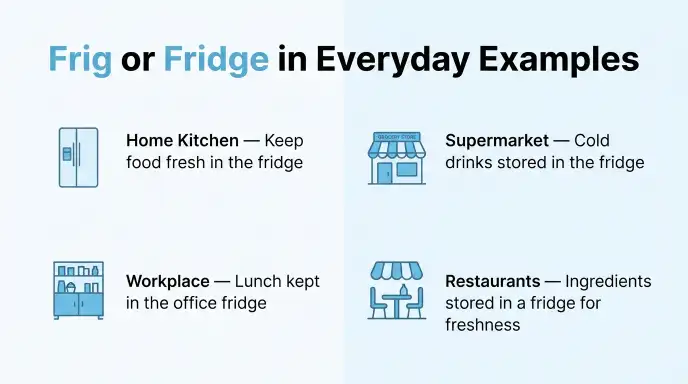
The word fridge is common in many types of everyday writing.
In Emails
Casual email:
“Please put the drinks in the fridge.”
A more formal version:
“Please place the drinks in the refrigerator.”
In News Writing
A casual news story might say:
“The family found the missing food inside the fridge.”
A formal report might use:
“The food was stored inside a refrigerator.”
On Social Media
Social media is usually casual, so fridge is natural.
Examples:
“My fridge is completely empty!”
“Time to clean out the fridge.”
“What is your favorite fridge snack?”
In Formal Writing
In academic, scientific, or professional writing, refrigerator is often a better choice.
Example:
“The samples were stored in a refrigerator at a controlled temperature.”
In Everyday Conversation
People normally say fridge.
For example:
“Can you get the water from the fridge?”
It would sound more formal to say:
“Can you get the water from the refrigerator?”
Both are correct, but fridge is more natural in casual conversation.
Frig or Fridge: Google Trends & Usage Data
People search for “frig or fridge” because they want to know which spelling is correct. Search interest can change over time and can also differ by country.
The word fridge has strong everyday usage because it is the common short form of refrigerator. It appears in searches about food storage, kitchen organization, appliance cleaning, recipes, repairs, and spelling.
The search term “frig or fridge” has a different purpose. People using this phrase are usually asking about spelling and word choice.
The exact popularity of these terms can vary by country and by search context. For example, someone searching for a kitchen appliance may search for fridge, while someone writing a technical document may search for refrigerator.
Search Intent for “Fridge”
Users may want:
- Refrigerator information
- Fridge organization ideas
- Fridge cleaning tips
- Food storage advice
- Appliance repair information
- Kitchen ideas
Search Intent for “Frig or Fridge”
Users are more likely to want:
- The correct spelling
- The difference between the words
- British vs American usage
- Word origin
- Grammar and vocabulary advice
This means an article targeting “frig or fridge” should answer the spelling question quickly and then provide clear supporting information.
Frig or Fridge: Keyword Variations Compared
| Keyword Variation | Correct? | Meaning | Recommended Use |
| Fridge | Yes | Refrigerator | Everyday English |
| Frig | Sometimes used | Refrigerator in rare usage | Usually avoid |
| Refrigerator | Yes | Cooling appliance | Formal writing |
| Frige | No | Intended to mean refrigerator | Avoid |
| Refridgerator | No | Intended to mean refrigerator | Avoid |
| Frig or fridge | Yes as a search phrase | Spelling question | search queries |
Do not force these phrases into every paragraph. Natural writing is easier to read and more useful.
FAQs
Can you spell fridge or frig?
The correct spelling is fridge, not “frig.” It’s the accepted short form of “refrigerator” in both American and British English. “Frig” occasionally shows up in casual texting, but dictionaries and style guides don’t recognize it as standard.
Why is it fridge and not frige?
This comes down to pronunciation and spelling conventions in English. The extra “d” in “fridge” keeps the “i” sound short, matching how the word is actually pronounced. Without that “d,” “frige” would visually suggest a long “i” sound, similar to words like “ride” or “side”: which isn’t how anyone says the word. That small “d” is what makes the spelling phonetically consistent.
What is correct, fridge or ref?
Both are used, but they’re not quite interchangeable. Fridge is the globally recognized term for a refrigerator and works in almost any English-speaking context. Ref, on the other hand, is regional slang: heard mostly in parts of the Philippines and among some Filipino English speakers: and isn’t widely understood outside that context. For general or international writing, fridge is the safer, more universal choice.
What do the British call a fridge?
In the UK, people simply say fridge, just like in American English. The full word “refrigerator” is rarely used in daily British conversation: it sounds overly formal for something so common in the kitchen.
What do they call a fridge in the USA?
Americans also use fridge in everyday speech, with “refrigerator” reserved for formal, technical, or product-related writing: think appliance manuals or store listings. In casual conversation, though, “fridge” is what you’ll hear almost everywhere.
What do the French call a fridge?
In French, a fridge is called a réfrigérateur, though most French speakers shorten it to frigo in everyday talk: much like English speakers shorten “refrigerator” to “fridge.” It’s a good example of how different languages naturally develop casual, shortened terms for common household items.
Conclusion
When choosing between frig or fridge, the answer is clear: fridge is the normal spelling for the short form of refrigerator. It is widely used in British English, American English, and other forms of global English.
The confusion comes from the way the word is shortened. At first, frig may seem more logical because it looks closer to the beginning of “refrigerator.” However, English spelling does not always follow simple shortening rules. Over time, fridge became the familiar spelling used in everyday English.
Use fridge in conversations, emails, social media posts, blogs, and other casual writing. Use refrigerator when you want a more formal or technical tone. Although frig can appear as a variant, it is uncommon and may cause confusion because it has other meanings.
Find Out More!

My name is James Whitemore, and I am a UK-based English language writer specializing in grammar, vocabulary, punctuation, and writing skills. At Grammer Vivo, I make complex English concepts easy to understand through clear explanations and practical examples, with a focus on both British and American English usage.